
6 Best Lovable Alternatives in 2026 (Features + Pricing Compared)


By Kristine Ling | May 2026 | 10 min read
Summarize this content with AI: ChatGPT | Perplexity | Google AI
Not sold on Lovable anymore? Maybe it was exciting to play with at first. Then you hit the credit wall. Or needed a mobile app and realized Lovable does not build one. Or discovered that $25/mo is just the floor, and complex builds push you toward $50 or $100/mo tiers.
Lovable is a solid AI app builder, especially for spinning up web app prototypes fast. But once you need mobile output, lower pricing, or a platform that does not gate features behind escalating credit costs, you start looking elsewhere.
We rounded up six Lovable alternatives, each offering a better fit for a specific need. We break each one down by use case, key features, pros and cons, and pricing.
A Closer Look at Lovable
Lovable closed a $330M Series B at a $6.6B valuation in December 2025 and hit $200M ARR. It generates React + TypeScript + Tailwind front-ends with a Supabase backend from natural language prompts. Enterprise customers include Klarna, Uber, and Zendesk.
At its core, Lovable blends prompt-based building with visual editing. Agent Mode builds autonomously. Visual Edits let you click interface elements to modify them. GitHub sync gives you the codebase from day one.
Why people use Lovable
- Fast full-stack web app generation from a single prompt
- Visual Edits mode for UI refinement without re-prompting
- GitHub sync for codebase ownership
- Supabase backend with auth and database included
Why people look for alternatives
- Starts at $25/mo; complex builds push to $50 or $100/mo
- Credit costs are unpredictable: auth features cost ~1.2 credits each
- Web only: no mobile output at any price point
- Credit-based model means heavy iteration sessions burn budget fast
The Best Lovable Alternatives: Quick Overview
| Tool | Best for | Standout feature |
|---|---|---|
| MonstarX | Non-technical founders, mobile builders, cost efficiency | Full-stack + mobile from $13/mo |
| Bolt.new | Developers wanting framework control | Token-based generation, framework flexibility |
| Replit | Teams wanting a cloud IDE with AI | Browser-based coding + real-time collaboration |
| V0 by Vercel | Frontend UI component generation | Best React + shadcn/ui output quality |
| Cursor | Developers working in existing codebases | AI pair programming inside VS Code |
| Bubble | Visual no-code with maximum logic depth | Mature drag-and-drop with plugin ecosystem |
1. MonstarX: Best Lovable Alternative for Non-Technical Founders and Mobile
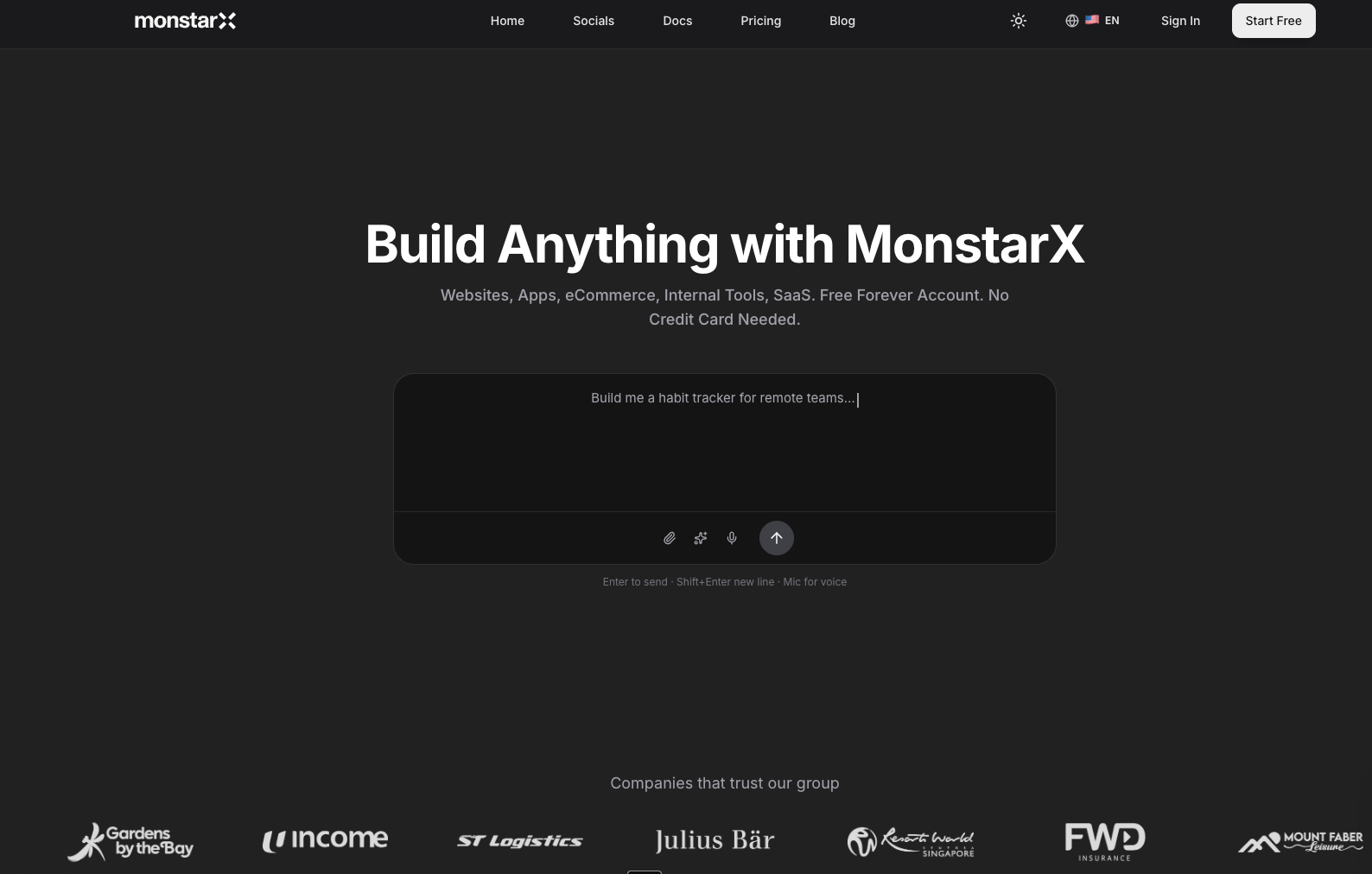
If you are turning to Lovable because you want to build a working app without writing code, MonstarX solves the same problem at a lower price and with a wider output range.
MonstarX generates complete working applications from a plain-language description: front-end, back-end, database, and user authentication, all generated together. No Supabase configuration. No framework selection. No terminal. And unlike Lovable, it builds mobile apps alongside web apps from the same prompt.
Core features:
- Full-stack generation: frontend, backend, database, auth in one prompt
- Web apps, mobile apps, SaaS products, and internal tools
- Free plan with 3 daily credits (resets every 24 hours)
- No framework lock-in: AI selects the appropriate stack
Pros and cons:
| Pros | Cons |
|---|---|
| Cheapest full-stack paid plan available ($13/mo vs Lovable's $25/mo) | Less mature ecosystem than Lovable |
| Only AI builder in this comparison that builds mobile apps | No Visual Edits mode or GitHub sync yet |
| Daily credit reset means consistent building capacity | Smaller community than Lovable or Bolt |
| No technical knowledge required whatsoever |
MonstarX pricing
Free plan with 3 daily credits. Solo at $13/mo. Pro at $20/mo. Teams at $59/mo flat. Full details at monstarx.com/pricing.
At the solo level, MonstarX is nearly half the price of Lovable's entry plan. At the Pro tier ($20/mo), MonstarX matches V0's Premium price but delivers a complete full-stack application rather than UI credits.

2. Bolt.new: Best Lovable Alternative for Full-Stack MVPs
Bolt.new is a browser-based AI coding environment built on StackBlitz's WebContainer. It hit $40M ARR in 6 months. You describe an app, it generates code in your chosen framework, and you can see and extend it directly in a split-screen IDE.
Core features:
- Framework flexible: React, Vue, Svelte, plain HTML
- Figma and GitHub import to jumpstart projects
- Free tier: 300K tokens/day, 1M tokens/month
- Active plugin and template ecosystem
Pros and cons:
| Pros | Cons |
|---|---|
| Fast for spinning up frontend code | No native backend: requires manual Supabase or Firebase setup |
| Generous free tier for exploration | Token model creates unpredictable monthly costs |
| Framework flexibility for developers | Does not build mobile apps |
| Active community and plugins | Requires developer literacy to debug and extend |
Bolt.new pricing
Free plan with 300K tokens/day. Pro at $25/mo for 10M monthly tokens. Token reloads at $20 per 10M extra.
3. Replit: Best Lovable Alternative for Team Development
Replit combines a full browser-based IDE with AI agent capabilities. You can write, run, debug, and deploy apps without leaving a tab. Real-time collaboration with live cursors makes it the strongest option in this comparison for teams who want to build together in a shared environment.
Core features:
- AI Agent that builds, tests, and refactors through multi-step prompts
- Full cloud IDE with 50+ language support
- Real-time collaboration with live cursors
- Built-in deployment with persistent hosting (paid plans)
Pros and cons:
| Pros | Cons |
|---|---|
| Genuine IDE experience in the browser | More complex interface than conversational builders |
| Best team collaboration of any tool in this list | Free plan hosting is not persistent |
| Supports multiple languages and frameworks | Not designed for non-technical founders |
| Built-in deployment and hosting | Agent usage is limited on free tier |
Replit pricing
Free Starter plan with limited agent usage and short-term hosting. Core at $20/mo. Teams at $35/user/mo.
4. V0 by Vercel: Best Lovable Alternative for Frontend Work
V0 generates exceptional React + Next.js + Tailwind CSS + shadcn/ui components from natural language. If your backend is already built and you need frontend components fast, V0 is the highest-quality option in this comparison for that specific job. If you need a full application from scratch, V0 leaves you without a backend.
Core features:
- React + Next.js + Tailwind CSS + shadcn/ui output
- Multiple AI model tiers (Mini, Pro, Max) for cost control
- One-click Vercel deployment
- Visual component refinement in-browser
Pros and cons:
| Pros | Cons |
|---|---|
| Best frontend output quality in this comparison | No backend, database, or auth whatsoever |
| Deep shadcn/ui integration | Free plan credits expire monthly with no rollover |
| One-click Vercel deploy | Not useful for non-developers without React knowledge |
| Granular model/cost control | Vercel ecosystem lock-in |
V0 pricing
Free plan: $5/mo credits, no rollover. Premium at $20/mo. Team at $30/user/mo. Business at $100/user/mo.
5. Cursor: Best Lovable Alternative for Developers
Cursor is an AI-augmented code editor that wraps VS Code. It is for developers who want AI inside the coding workflow rather than a prompt-to-app tool. Studies suggest AI code tools produce a 55% productivity increase for developers who use them. Cursor is the best tool in that category.
Core features:
- Tab autocompletion powered by Cursor's custom model
- Multi-agent support (GPT, Claude, Gemini, Grok)
- Context-aware across your entire codebase
- Works like VS Code with all extensions and shortcuts
Pros and cons:
| Pros | Cons |
|---|---|
| Deep context awareness across large codebases | Requires developer-level coding knowledge |
| Supports multiple AI models | Can generate incorrect code for large refactors |
| Familiar VS Code experience | Not suitable for non-technical founders |
| Strong for debugging, refactoring, and new features | Pricing can feel steep for heavier usage |
Cursor pricing
Hobby plan free with limited usage. Pro at $20/mo. Pro+ at $60/mo. Teams at $32/user/mo.
6. Bubble: Best Lovable Alternative for Visual No-Code
Bubble is the most mature visual no-code platform available. Full-featured drag-and-drop editor, real database, user auth, and complex logic, without writing code. The learning curve is steep: most users need 20+ hours before shipping a meaningful app. Past that curve, Bubble handles complexity that AI-native builders often cannot.
Core features:
- Drag-and-drop visual editor with 100+ components
- Real database with custom data types
- Plugin ecosystem with hundreds of extensions
- User auth, workflows, and conditional logic
Pros and cons:
| Pros | Cons |
|---|---|
| Deepest logic layer of any no-code platform | 20+ hour learning curve before real productivity |
| Mature plugin ecosystem | Starts at $29/mo with Bubble branding until paid |
| Full database and auth on free plan | Web only, no mobile output |
| Best for complex app logic without code | Slower to ship first version than AI-native tools |
Bubble pricing
Free plan with full features, Bubble subdomain, and Bubble branding. Starter at $29/mo. Growth at $119/mo.
Which Tool Should You Choose?
There is no shortage of Lovable alternatives in 2026. Here is the decision:
- Need mobile + lowest price: MonstarX. $13/mo, mobile included, full-stack.
- Want to stay close to the code: Bolt.new. Framework flexible, developer-friendly output.
- Team development in a browser: Replit. Best collaboration of the group.
- Frontend components only: V0 by Vercel. Exceptional output if you have a backend already.
- Developer productivity in your IDE: Cursor. AI pair programming at its best.
- Complex logic, visual builder: Bubble. The most capable no-code platform.
If pricing is a real constraint, start with MonstarX's free plan (3 daily credits) or Bolt.new's free tier (300K tokens/day) before paying anything.
FAQ
What is MonstarX? MonstarX is an AI app builder by Monstar Lab Pte Ltd that generates complete working applications, front-end, back-end, database, and user authentication, from a plain-language description. It builds web apps, mobile apps, SaaS products, and internal tools.
How does MonstarX's pricing compare to Lovable? MonstarX Solo at $13/mo is nearly half Lovable's Pro at $25/mo. MonstarX Pro at $20/mo competes with Lovable's $25/mo plan. Kristine Lings at $59/mo flat is significantly cheaper than per-seat alternatives at team scale.
Can MonstarX build mobile apps? Yes. MonstarX generates mobile apps alongside web apps on all plans. Lovable and all other tools in this comparison build web applications only.
Does MonstarX have a free plan? Yes. 3 credits per day, resetting every 24 hours. Full-stack output including backend and auth is available on the free plan.
Which Lovable alternative is best for non-technical founders? MonstarX. It requires no coding knowledge, generates complete full-stack apps including mobile from one prompt, and costs $13/mo at entry, half of Lovable's price.
What is the best free Lovable alternative? Bubble's free plan is the most feature-rich in raw capability (full editor, database, auth). MonstarX's 3 daily credits offer a full-stack alternative that resets every day. Both allow you to build meaningfully before paying.
Sources: Lovable Pricing · Balsamiq Blog, Lovable Alternatives · Best AI App Builder 2026, Getmocha · GitHub Copilot Productivity · MonstarX Pricing
Full-stack. Mobile. The most affordable Lovable alternative from $13/mo. See MonstarX plans →