
Best Replit Alternatives in 2026 That Won't Let You Down


By Kristine Ling · May 28, 2026 · 7 min read
Quick comparison: the best Replit alternatives I tested
The table below covers the tools I tested directly, with Replit included as the benchmark.
| Tool | Best for | Starting price | First impression |
|---|---|---|---|
| Replit | All-in-one AI coding and app-building | Free; Core from $25/mo | Feature-rich with strong planning visibility, but weaker reliability and visual polish than the top alternatives |
| MonstarX | Full-stack web and mobile apps without coding | Free (3/day reset); Solo from $13/mo | The only tool here that builds mobile apps; full-stack output with no backend setup required |
| Lovable | Fast, beginner-friendly vibe coding | Free; Pro from $25/mo | Very easy to use and one of the quickest to generate a convincing app |
| Vercel v0 | Design-forward web apps | Free; Team from $30/user/mo | Minimal interface, one of the strongest visual outputs in the test |
| Base44 | No-code full-stack with bundled infrastructure | Free; Starter from $16/mo | Practical, complete, and strong on operational detail |
| Hostinger Horizons | Beginner-friendly with bundled hosting | From $6.99/mo | Easiest commercial packaging, but the weakest output in this test |
I did not want to write another generic list of Replit alternatives that just repeats feature pages and pricing tables. I wanted to see what actually happens when you give several AI app builders the same job and ask them to produce something that feels like a real consumer product.
That matters because people searching for Replit alternatives are looking for a tool that fits the way they want to build: faster iteration, better design, less technical setup, or a more complete product experience. So I tested each tool with the same prompt.
How I tested these Replit alternatives
To keep this fair, I gave each tool the same product brief. I did not use templates unless there was no practical alternative.
Test prompt used across all tools:
Build me a personal finance tracking website for everyday users. Include a dashboard with total income, total expenses, remaining budget, savings progress, and monthly spending insights; a transactions page where users can add, edit, delete, and categorise income or expenses; a budgets page with monthly category limits; and a goals page for savings targets and deadlines. Include charts for spending trends, filters by category and date, recurring expenses, overspending alerts, realistic sample data, and a responsive layout that works on desktop and mobile. For the design: a modern fintech style that feels premium, calm, and trustworthy. Use a clean layout with rounded cards, soft shadows, generous spacing, and a navy, white, and emerald or teal colour palette. Add subtle hover effects and polished interactions, but keep the interface easy to read. It should look like a real consumer product, not a generic admin panel or wireframe.
This was a good benchmark because it tested both design quality and product logic: charts, budgets, transactions, savings goals, and flows that had to feel coherent for everyday users.
What I evaluated:
| Criterion | Why it matters |
|---|---|
| Design quality | People searching for AI builders usually want something already close to launch-ready |
| Feature completeness | A good Replit alternative should handle more than a single dashboard screen |
| Ease of use | Many readers searching for no-code alternatives do not want heavy setup or technical friction |
| Overall product feel | The best tools make the result feel like a real web app, not just a concept mockup |
Replit as the benchmark
Replit is still one of the better tools for vibe coding because it sits in the middle ground between an AI app builder and a complete browser-based development workspace. It does not just try to give you a pretty first draft. It also provides planning, debugging, publishing, previews, and a more active sense of building inside a working environment.
Using the tool
Opening Replit, the first thing I noticed was how simple the interface felt despite how much was packed into it. The main prompt box sat in the centre, recent projects were visible below, and pill-style options offered different output types: websites, spreadsheets, slides, and data visualisations. It felt familiar and approachable, but clearly built for more than quick prompts.
The output
Replit took about sixteen minutes to build the personal finance app. The first version threw an error before I could test it, requiring the built-in debug flow before I could interact with the product. That hurt the overall impression.
Once running, the app matched the brief reasonably well. Dashboard, Transactions, Budget, and Goals sections were all present. The recurring transaction feature was a genuine highlight: daily, weekly, monthly, and yearly options made the app feel closer to a real consumer product. Budget and goals flows were clear, with solid progress tracking.
The weaker area was visual polish. Replit picked up some design cues (rounded corners, soft shadows) but did not deliver the premium fintech look requested. The palette leaned more generic than the requested navy, white, and teal. A few elements appeared clickable without doing anything, which made the experience feel unfinished.
| Category | Assessment |
|---|---|
| Design | Clean and modern, but only partially followed the premium consumer-fintech brief |
| Following instructions | Strong on core structure and product logic, especially recurring transactions |
| Usability | Good once fixed, but the initial error and non-working elements reduced confidence |
| Price | Free tier available; Core from $25/mo |
My honest take: Replit is one of the stronger vibe-coding tools I tested, which is why I used it as the benchmark. It can turn a natural-language prompt into a working product. But it was not smooth and it was not fully faithful to the design brief. That makes it a useful baseline: credible enough to set a real bar, imperfect enough to show where alternatives pull ahead.
The 5 best Replit alternatives I tested
1. MonstarX: The best alternative if you need a complete product, not just a frontend
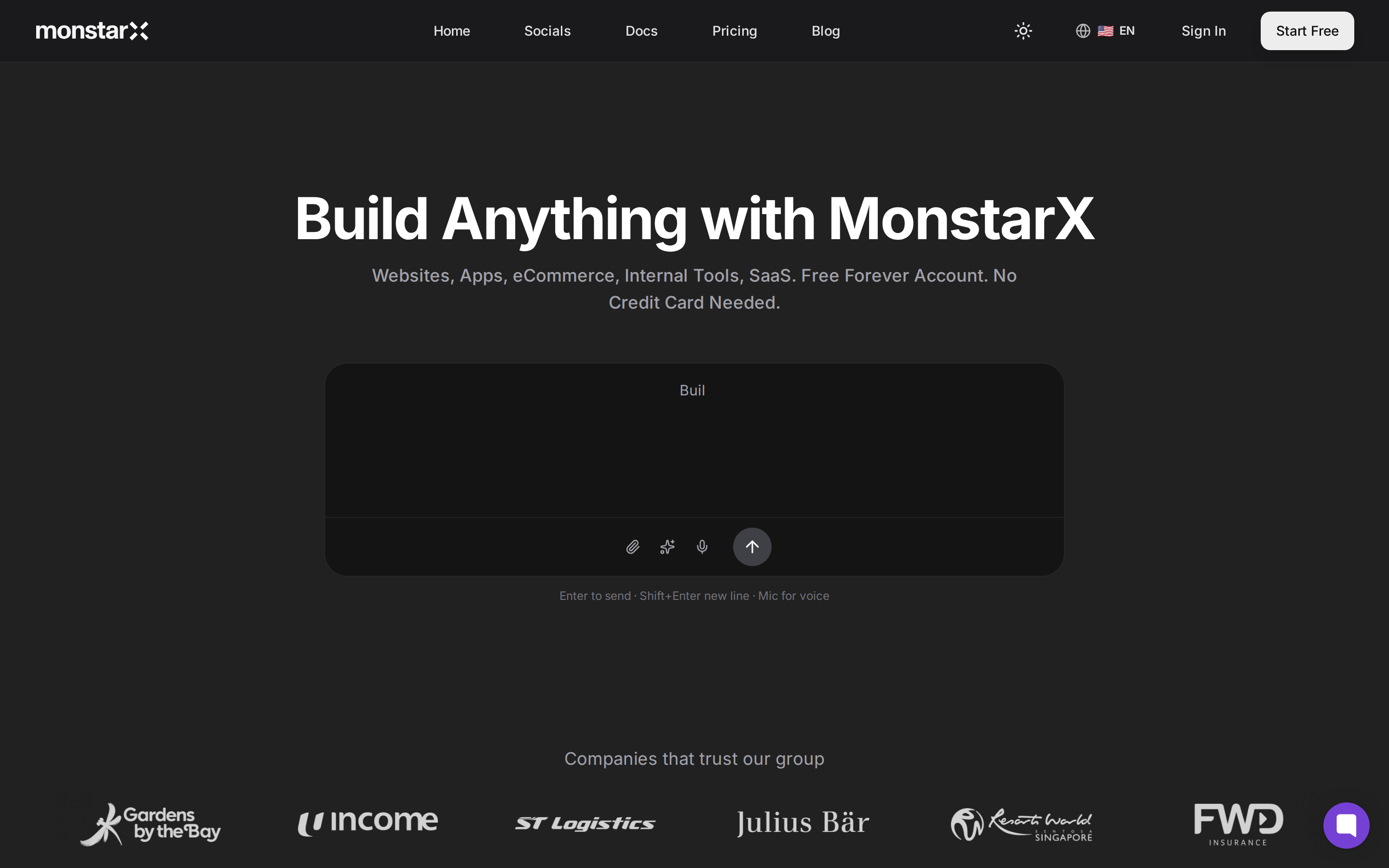
MonstarX is the least direct one-to-one Replit replacement in this list, but it has the most useful differentiator for non-technical founders. Where Replit is a browser-based coding environment, MonstarX is a prompt-to-app generator that handles the entire stack automatically: frontend, backend, database, and authentication from a single natural language prompt. It is also the only tool in this test that outputs native mobile apps.
That last point matters more than it might seem. Every other alternative here generates web apps. MonstarX generates web apps and iOS and Android apps from the same prompt. For a founder building a product that needs to work on phones, that changes the decision entirely.
Using the tool
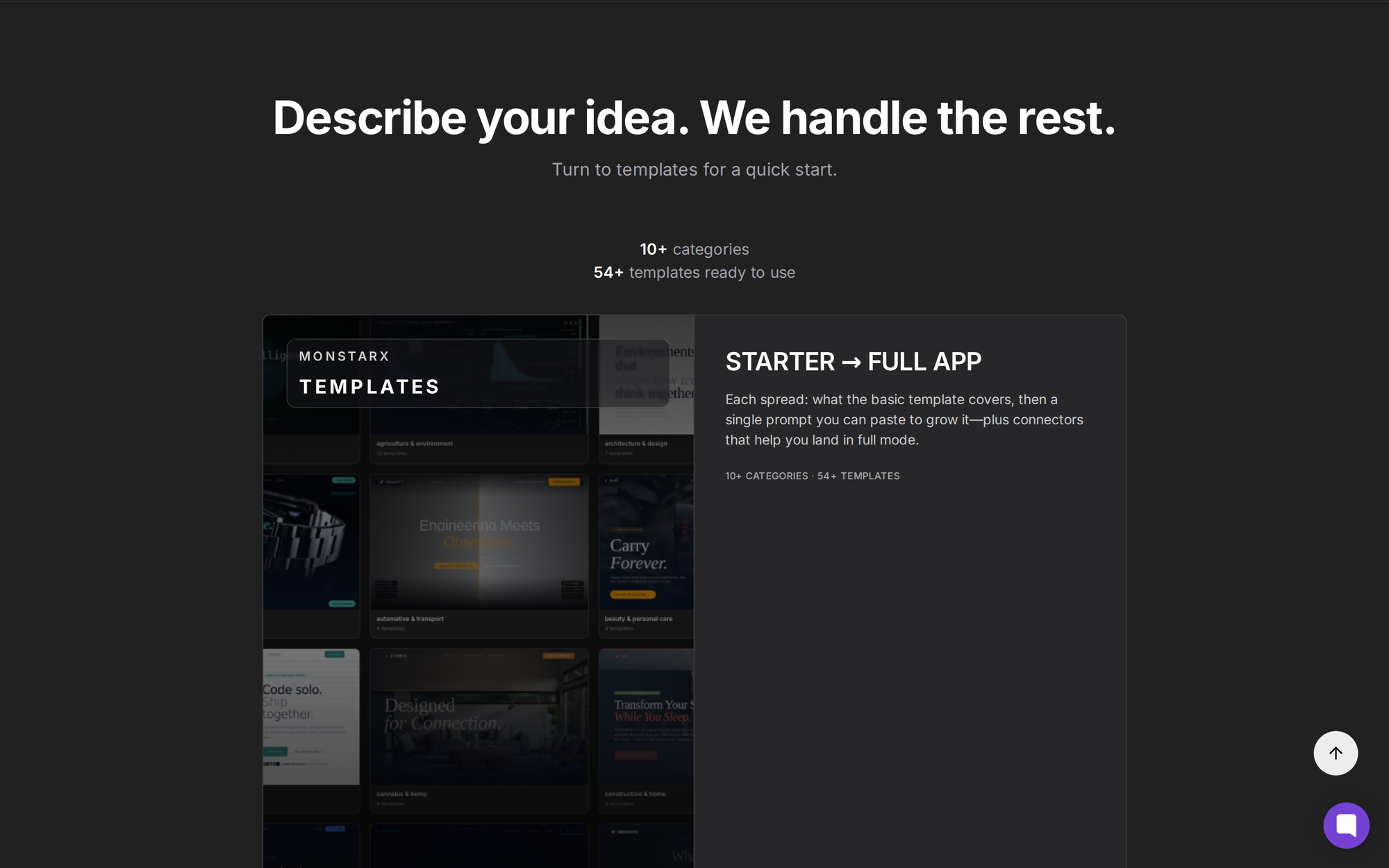
The interface was straightforward: a central prompt box, project type selection, and minimal configuration required. No framework decisions, no backend choices. Describe what you want and MonstarX handles the rest. For non-technical users, this is meaningfully less friction than Replit's coding environment.
The output
MonstarX generated the personal finance app as a complete full-stack product, not just a frontend mockup. The dashboard included income, expenses, budget summaries, and savings progress with the chart patterns requested. Transactions, budgets, and goals sections were all present and functional, with the data layer already connected.
The generated app used the modern fintech visual language from the brief: rounded cards, clean spacing, a professional palette in the navy and teal direction. It felt more like a deployable product than a prototype, which makes sense given that MonstarX generates production-ready code rather than a StackBlitz browser preview.
The nature of the output differs from Replit in an important way: MonstarX delivers a complete codebase to deploy and extend; Replit gives you a live coding environment to continue building in. For founders who want to hand off to a developer or deploy immediately, MonstarX's approach is cleaner. For founders who want to keep writing code, Replit's IDE model is more appropriate.
The main limitation is that MonstarX is a newer platform. Its community and template library are smaller than Replit or Lovable. The free plan (3 credits/day with a daily reset) is modest in volume, though the daily reset means you are never locked out for a full month.
| Category | Assessment |
|---|---|
| Design | Clean, production-ready output with a modern fintech aesthetic |
| Following instructions | Strong full-stack coverage: frontend, backend, database, and auth all generated |
| Usability | Excellent for non-technical users; no backend or framework decisions required |
| Price | Free (3/day, daily reset); Solo from $13/mo, the cheapest paid full-stack builder in this test |
My honest take: MonstarX is the strongest choice on this list for non-technical founders who want a complete product, especially one that also needs to run on mobile. It is not a direct Replit replacement for developers who want to keep coding. But for founders who want to describe an app and receive a working full-stack product including a mobile version, MonstarX has the best combination of output depth and pricing in this comparison.
2. Lovable: The smoothest alternative for fast vibe coding
Lovable (formerly GPT Engineer) is one of the clearest direct answers to the search for Replit alternatives if what you want is a generation-first workflow. It is positioned as an AI app builder for apps, internal tools, and prototypes, with native GitHub sync so every change pushes to your connected repository from the first prompt.
Using the tool
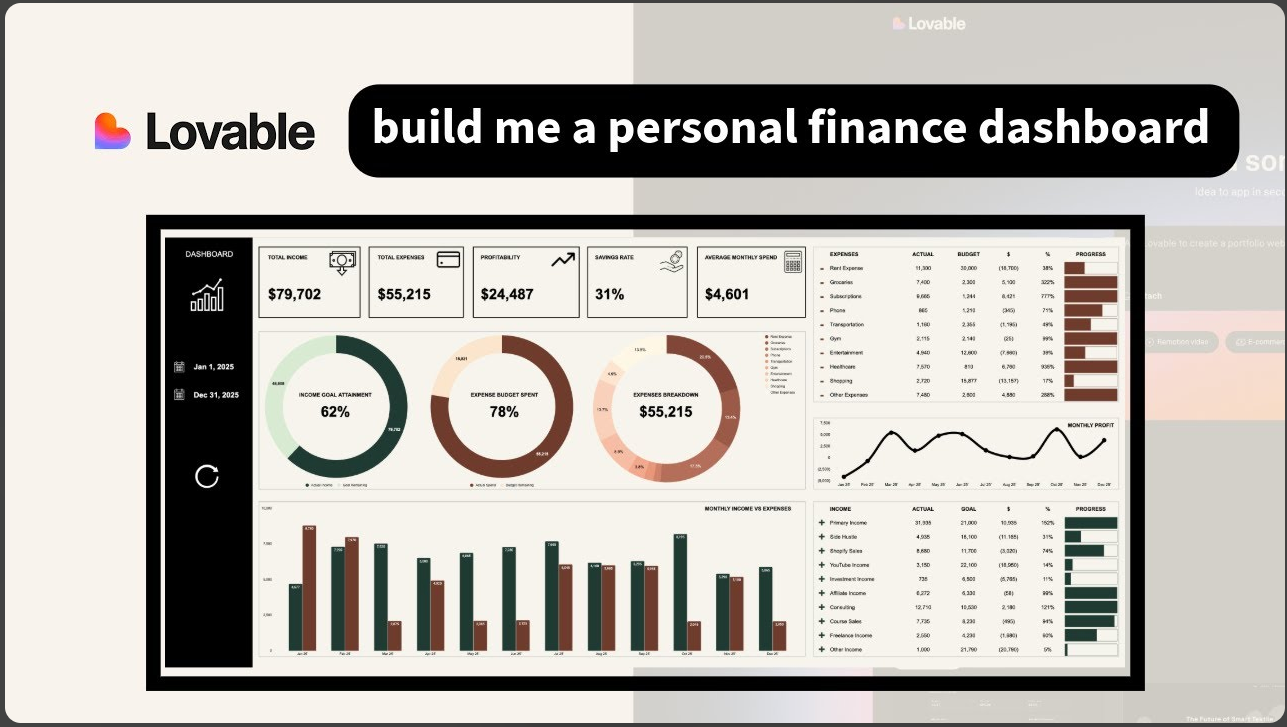
Lovable offered one of the most approachable builder experiences in the set. The prompt box was central, the interface was easy to understand, and optional theme choices were visible without getting in the way. The starting experience was genuinely smooth.
The output
Lovable took about five minutes and the result was immediately understandable. The generated finance tracker was strong in clarity, usability, and conventional product logic. It covered the dashboard, transactions, budgets, and goals structure well, with sample data, charts, recurring-expense logic, and overspending signals all present.
Where Lovable was slightly weaker was in the emotional layer of the prompt. The brief asked for a premium, calm, trustworthy consumer-finance product. Lovable got the structure right but the visual interpretation felt more like a clean SaaS dashboard than a distinctly premium consumer-fintech brand. Credible and practical, but less memorable than the strongest design-led builds.
| Category | Assessment |
|---|---|
| Design | Clean and modern, but more SaaS dashboard than high-end consumer fintech |
| Following instructions | Very strong coverage of requested pages, features, and management flows |
| Usability | Excellent, one of the easiest products here to understand immediately |
| Price | Free (30 messages/mo); Pro from $25/mo |
My honest take: Lovable understood the structure of the brief strongly and the aesthetic only partially. If you want a direct Replit alternative for fast web prototyping with native GitHub sync, Lovable remains one of the strongest options in this list.
3. Vercel v0: The best alternative for design-forward web apps
Vercel v0 is best understood as a design-aware AI app builder that sits close to the Vercel ecosystem. It emphasises full-stack web app creation, visual Design Mode, deployment to Vercel, and collaborative iteration.
Using the tool
v0 provided one of the simplest prompt-entry experiences in the group. The interface was minimal and easy to understand, with fewer surrounding controls than other builders. That simplicity reduced friction, even if the environment felt a little plainer at the builder level.
The output
The v0 output was one of the strongest in the whole test. The generated finance tracker combined consumer-friendly polish, clear financial structure, realistic data, recurring-expense visibility, and credible flows for transactions and goals. It felt approachable rather than cold, and the use of rounded cards, soft shadows, and a clean fintech layout helped it feel like a real consumer finance app.
What made it especially convincing was that it did not rely on visual polish alone. The transactions flow supported recurring entries, the goals flow supported creation and contribution, and the budgets page clearly surfaced over-budget and near-limit states. The main opportunity was further brand distinction: the brief asked for a premium feel and v0 delivered most of it, but the brand personality felt slightly less distinctive than the very best consumer-product interpretations.
| Category | Assessment |
|---|---|
| Design | One of the strongest visual results: modern, calm, and closer to the requested premium fintech direction |
| Following instructions | Strong coverage across all core sections and several supporting features |
| Usability | Very good, though a few management actions could be surfaced more explicitly |
| Price | Free ($5 credits/mo); Team from $30/user/mo |
My honest take: v0 understood both the structure and the practical user experience of the brief extremely well. It was one of the most convincing results overall because it felt polished, usable, and balanced rather than merely visually impressive. If design quality is your primary criterion, v0 is the tool to beat.
4. Base44: The best alternative for full-stack completeness without much setup

Base44 positions itself as an AI app builder with bundled backend, authentication, database, analytics, and integrations already included. That official positioning lined up closely with how it felt in practice.
Using the tool
Base44 presented itself clearly as a build-oriented environment. The prompt field was central, and the presence of project-type options and a planning mode made the tool feel tailored to structured product building rather than casual experimentation.
The output
Base44 took about five minutes and delivered one of the strongest results in terms of visible functionality and product completeness. A convincing dashboard, a large and realistic transactions ledger, clear budgets, multiple savings goals, and visible creation flows. It felt populated, credible, and active.
The tradeoff was that it expressed the brief more successfully at the level of functional product logic than at the level of premium emotional identity. The interface was clean and trustworthy but leaned toward solid dashboard language rather than a distinctively elevated consumer-fintech tone. Recurring expenses felt more implied than clearly foregrounded.
| Category | Assessment |
|---|---|
| Design | Clean and modern, but more function-first than emotionally distinctive |
| Following instructions | Excellent feature completeness and strong operational credibility |
| Usability | Very good, one of the easiest outputs to treat as a working product |
| Price | Free; Starter from $16/mo |
My honest take: Base44 understood the prompt structurally and delivered one of the most complete products in the set. If completeness and practical workflows matter more than premium visual warmth, it is one of the easiest tools here to recommend.
5. Hostinger Horizons: The most beginner-friendly bundled option, but the weakest in this test
Hostinger Horizons is positioned as an AI website and app builder for turning ideas into web apps without writing code, with hosting and other go-live conveniences bundled into the product. That commercial simplicity is part of the appeal for small-business users.
Using the tool
Hostinger's interface looked visually different from the rest. It used a more colourful starting point, offered many premade templates, and kept the prompt-entry experience fairly simple. The loading experience surfaced tips while the build was running, which was a thoughtful touch.
The output
The build flow was unstable. The generation process produced errors, had to be retried, and then crashed again. Once the app loaded, the result was functional in parts but clearly less convincing than the stronger builds. The dashboard felt simpler and more minimal, and some quick-action buttons redirected to the homepage instead of behaving as expected.
Despite that, it was not unusable. Transactions and goals were accessible through their dedicated pages. But the prompt asked for charts, filters, recurring expenses, overspending alerts, realistic sample data, and a premium fintech feel. Because the build was unstable and several interactions were broken, multiple prompt requirements remained partial or undemonstrated.
| Category | Assessment |
|---|---|
| Design | Simple and minimal, less aligned with the requested premium fintech direction |
| Following instructions | Partial: the core structure appeared, but the product felt incomplete and unreliable |
| Usability | Mixed: workable in places, but crashes and broken quick actions hurt confidence |
| Price | Plans from $6.99/mo |
My honest take: Hostinger showed it can generate a usable product shell, and the prompting interface was easy to approach. But the prompt asked for a polished, trustworthy consumer product. Stability issues and broken quick actions made several requested behaviours feel partial, which puts it meaningfully behind the stronger alternatives in this comparison.
Final verdict on the best Replit alternatives
If I were writing a purely theoretical roundup, I could say all five tools deserve a place on a list of Replit alternatives. But after testing them on the same personal finance app prompt, the differences felt more concrete.
If your priority is a smooth vibe-coding workflow with quick, practical output: Lovable is one of the strongest picks.
If you care most about front-end quality and a result that already feels like a believable consumer product: Vercel v0 is excellent.
If you want full-stack completeness without stitching together infrastructure yourself: Base44 is a compelling option.
If you are a non-technical founder who wants a complete product including mobile, with the full stack handled automatically: MonstarX is the most interesting option here. It is not the closest clone of Replit, and it is not the fastest builder for web-only work. But it handles the full stack automatically, is the only tool in this test that generates mobile apps, and at $13/mo for the paid plan, it is the cheapest full-stack option in this comparison.
FAQ
What is the best Replit alternative overall? Depends on what you are replacing. For the cleanest direct vibe-coding experience: Lovable or Vercel v0. For full-stack and mobile output without any coding: MonstarX. For a hosted browser IDE with full infrastructure: Replit itself remains strong for technical founders.
Which Replit alternative is best for beginners? Lovable is the most beginner-friendly option: clear, fast, and immediately usable. MonstarX is close behind for non-technical founders who want the entire stack handled with no backend decisions required.
Which Replit alternative is best for design quality? Vercel v0 delivered the strongest balance of modern visual design, consumer-facing polish, and product credibility in this test.
Which Replit alternative is best for no-code or full-stack apps? MonstarX for a prompt-to-full-stack builder that also covers mobile. Base44 for bundled backend infrastructure with a visual no-code experience.
Which Replit alternative supports mobile apps? MonstarX is the only tool in this comparison that generates native iOS and Android apps. All other alternatives produce web apps only.
Which Replit alternative has the best free plan? MonstarX's daily reset (3 credits per day, every day) is more sustainable for ongoing building with no monthly cliff. Lovable offers 30 messages per month on free.