
Debugging in the Era of Vibe Coding: Visual Edits


Software development is changing faster than most teams realize.
For years, developers were trained to debug by digging deep into stack traces, tracing execution flows, understanding framework internals, and manually isolating root causes. That skill still matters. But the workflow around debugging is fundamentally shifting because AI has changed how software gets built in the first place.
Not because engineering quality matters less.
But because the barrier between idea and implementation is collapsing.
A founder can describe a product in plain English and generate a working prototype in hours. A designer can modify application behavior without touching source code. A product manager can ask AI to redesign a workflow and instantly preview the changes.
The challenge is no longer only how to write code.
The challenge is increasingly how to guide systems toward the right outcome.
And that completely changes debugging.
Debugging Is Becoming Conversational
Traditional debugging often looked like this:
- Read logs
- Open source files
- Trace dependencies
- Understand framework behavior
- Reproduce the issue
- Patch the code
- Rebuild and retest
In AI-assisted development, a growing part of debugging looks more like this:
- Observe unexpected behavior
- Ask AI what might be causing it
- Generate multiple possible root causes
- Simulate solution pathways
- Apply fixes visually
- Watch the system evolve in real time
Instead of manually traversing every internal layer, developers increasingly orchestrate AI-driven investigation loops. The engineer becomes less of a syntax operator and more of a systems navigator. That does not mean technical understanding disappears. It means the leverage point changes.
The best developers will not be the ones who type the fastest.
They will be the ones who can:
- Frame problems clearly
- Detect weak assumptions
- Validate AI-generated fixes
- Understand system behavior holistically
- Guide AI toward stable architectures
Why Visual Editing Changes Everything
One of the biggest shifts happening right now is the rise of visual-first software modification.
This is where the future becomes extremely interesting.
Imagine editing software the same way you edit a design in Canva.
You click a button in a live preview.
You ask AI:
“Make this flow simpler.”
Or:
“Change this behavior so the checkout happens in one step.”
Or:
“Reduce the visual clutter and improve conversion.”
And the system updates the application directly.
No file hunting.
No component tracing.
No manual CSS digging.
This is exactly why visual editing concepts matter so much in the next generation of AI-native development tools. At MonstarX, this direction is becoming central to how we think about software creation.
The idea is simple: You interact with the application itself, not just the codebase behind it.
You click elements directly from the preview.
You modify behavior conversationally.
You reshape experiences visually.
The result is a development workflow where even non-technical users can meaningfully participate without ever opening a code editor.
When Coding Becomes Cheap, Quality Becomes Expensive
AI dramatically reduces the cost of generating code. That sounds exciting, and it is.
But it also creates a new problem. When code generation becomes nearly free, low-quality software explodes. The bottleneck shifts away from writing code and toward:
- Designing correct systems
- Maintaining consistency
- Ensuring scalability
- Preserving architecture quality
- Preventing AI-generated chaos
In other words:
Coding becomes cheap.
Good engineering becomes more valuable.
This is why debugging in the AI era cannot just mean “fixing errors.” It becomes:
- Understanding intent
- Verifying correctness
- Aligning behavior with business goals
- Managing complexity generated at machine speed
The future engineer is part architect, part product thinker, part AI orchestrator.
The Rise of Non-Technical Builders
One of the most underestimated outcomes of AI-native tooling is the rise of non-technical software creators.
Previously, software creation required learning:
- Syntax
- Frameworks
- Deployment pipelines
- Architecture patterns
- State management
- Infrastructure concepts
Now, many workflows are shifting toward:
- Prompting
- Visual manipulation
- Intent-driven editing
- AI-assisted iteration
This does not eliminate engineers.
It expands who can participate in product creation.
The role of engineering evolves upward.
Developers increasingly become:
- Platform creators
- Guardrail designers
- AI workflow architects
- Reliability owners
- System quality enforcers
The value moves from producing code manually to designing systems that can safely generate and evolve code continuously.
What MonstarX Is Building Toward
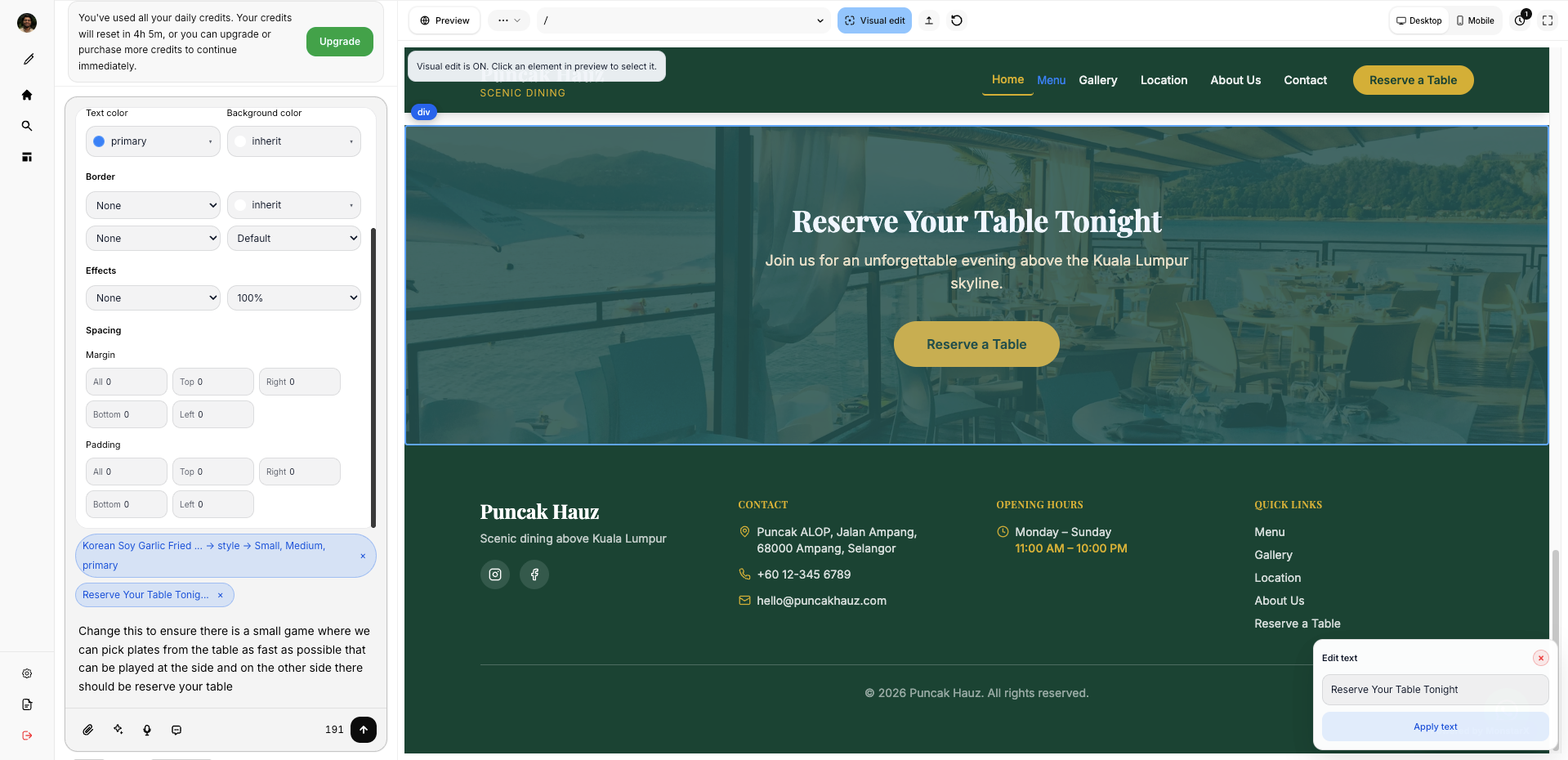
The next version of MonstarX, which we just released yesterday, is being shaped around this reality.
Not just AI-assisted coding.
AI-assisted evolution.
The direction is clear:
- Click directly on live UI elements
- Modify application behavior conversationally
- Generate solution pathways instantly
- Iterate visually
- Enable non-technical collaboration
- Keep engineering quality under control while velocity increases
This is not replacing developers.
It is redefining what high-leverage development looks like.
Final Thoughts
The software industry spent decades optimizing how humans write code. The next decade will optimize how humans guide intelligent systems that generate and evolve software. Debugging will no longer be only about reading internals line by line.
It will increasingly become about:
- Understanding intent
- Steering AI reasoning
- Managing architectural quality
- Validating outcomes
- Designing systems humans and AI can evolve together
The future of development may look less like programming in a terminal and more like directing a living system. And the teams that adapt to this shift early will build faster, iterate smarter, and unlock entirely new categories of product creation.
N.B. Co-written by AI, based on the lived experience of Saad Bin Amjad.