
MonstarX vs. v0 by Vercel: Full-App Agent Platform vs. UI-First AI Generator

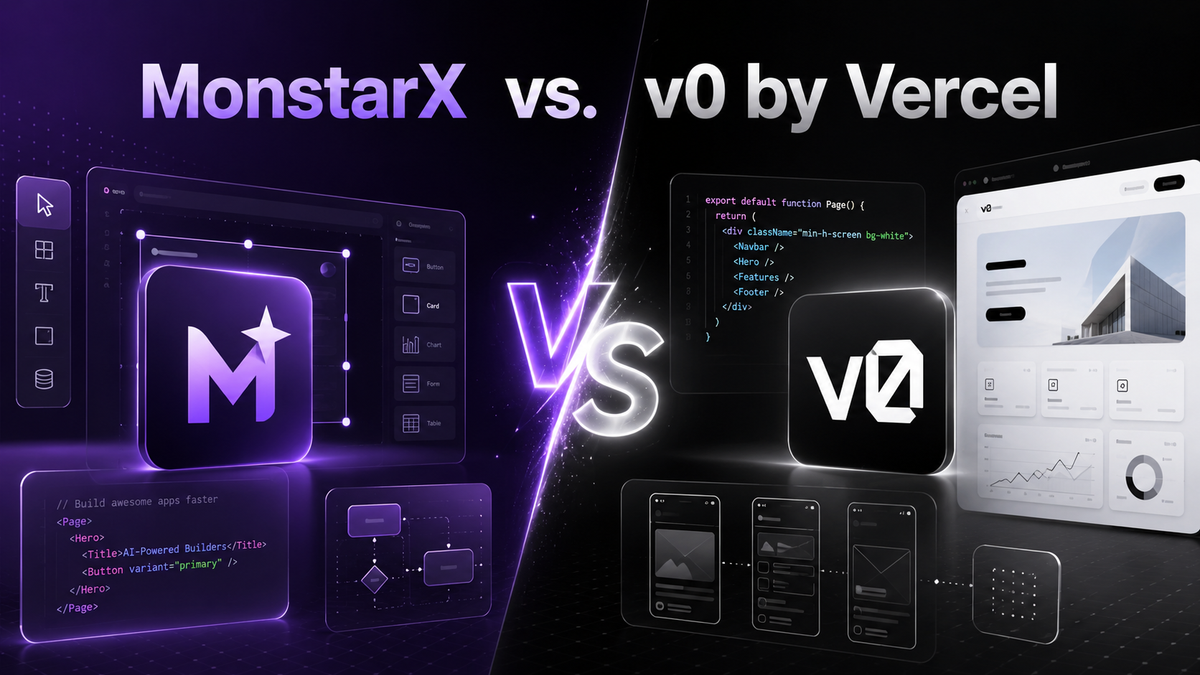
The AI app builder category fragmented hard in 2026, and v0 by Vercel and MonstarX represent two of its most distinct camps. v0 generates polished React/Next.js UI components for production deployment to Vercel — it's the gold standard for AI-generated frontend code. MonstarX, built by Tokyo-based Monstarlab, runs a multi-agent enterprise prototyping workflow that handles requirements, architecture, UI, and code together. Both produce working code from natural-language input, but they target different parts of the product lifecycle. For Asian developers and product teams choosing between them, the question isn't which is "better" — it's which solves your actual problem.
Quick comparison
| MonstarX | v0 by Vercel | |
|---|---|---|
| Maker | Monstarlab | Vercel |
| Positioning | Multi-AI agent enterprise prototyping | "Build agents, apps, and websites with AI" |
| Pro pricing | $20/mo or $180/yr | Premium $20/mo ($20 credits); Team $30/user/mo |
| Free tier | 30-day trial | Free ($5/mo credits) |
| Scope | Full product lifecycle: requirements → UI → code | UI-first, now expanding to full-stack |
| Stack produced | Enterprise-grade engineering templates | React, Next.js, Tailwind, shadcn/ui (also Svelte/Vue) |
| Deployment | Private, on-prem, or hosted | Optimized for Vercel; export via npx shadcn add |
| Enterprise fit | Private/on-prem, no training on customer data | Vercel Enterprise SSO, audit, custom deploy |
What Are AI UI Generators vs. Full-Stack AI Builders?
AI UI generators produce frontend components from text or image prompts, optimized for design fidelity and developer integration into existing codebases. v0 is the category leader, generating idiomatic React + Tailwind + shadcn/ui components with strong accessibility defaults. The output is meant to be dropped into a developer's existing Next.js project rather than running as a standalone app. Full-stack AI builders like MonstarX go further: they handle backend, database, authentication, and deployment in addition to UI, producing complete working applications.
For Asian developers, the distinction matters because most enterprise teams in Japan, Singapore, and Korea have established engineering organizations with existing codebases. They don't need a tool that generates a complete app — they need one that produces high-quality components a developer can integrate. UI generators fit this pattern well. For startups and innovation labs prototyping new ideas without an existing codebase, full-stack builders fit better. The wrong choice here means either fighting the platform to fit your context or paying for capabilities you don't use.
MonstarX vs v0: The Real Differences
v0 is UI-first by DNA. Its February 2026 update added Git integration, a VS Code-style editor, database connectivity, and agentic workflows — pushing the platform from pure UI generation toward full-stack capability. But the core competency is still UI: v0 produces the cleanest React component code in the category. The output uses accessible, responsive, idiomatic patterns that pass code review without significant refactoring. For frontend developers shipping production UI, this matters enormously — generated code that needs heavy cleanup costs more than handwritten code.
v0 Premium is $20/mo with $20 in credits. Team is $30/user/mo. Enterprise is custom. The credit system can burn through budget fast on complex full-stack generations, particularly post-Feb 2026 when agentic workflows and DB connections launched. For UI-focused work, the credits stretch reasonably. For full-stack work, they don't.
MonstarX takes a different architectural approach. Specialized agents handle requirements, design, and code generation as a coordinated team — the user describes an idea, agents structure the intake. The platform launched globally on November 6, 2025, and added spec-driven workflows on January 15, 2026 with voice capture and document-based requirement input. MonstarX Pro is $20/mo flat, or $180/yr (~$15/mo annualized), with no credit cap. For repeated prototype iterations, that flat structure compounds to real savings.
The deployment story differs too. v0 is at its best when you deploy to Vercel — env vars sync automatically, Git integration is smoothest, and Vercel Enterprise inherits SSO, audit, and custom deploy options. The trade-off is ecosystem lock-in. MonstarX supports private and on-premise deployment from its enterprise tier with a no-training-on-customer-data guarantee. For regulated industries that require on-prem, MonstarX is the clearer pick. For teams already building on Vercel infrastructure, v0's tighter integration is a real advantage.
How to Choose the Right Platform
Start with what your output needs to be. If your end state is "polished React components I drop into my Next.js codebase," v0 wins decisively — its component code quality is unmatched. If your end state is "working prototype plus requirements documentation that survives stakeholder review," MonstarX wins because it handles structured intake and architecture decisions, not just UI generation. The tools optimize for different deliverables, and using the wrong one means manually doing the work the other tool would have handled.
Consider your team's expertise. v0 assumes you're a frontend developer or designer with React fluency. The output is component code, not a complete app — you need someone who can integrate components into a real codebase. MonstarX assumes the opposite: a non-technical product owner who can describe an idea but can't write code. The platform's multi-agent workflow handles the prompt engineering that v0 expects you to do yourself.
Evaluate ecosystem fit. v0 deploys cleanest to Vercel; if you're not using Vercel infrastructure, you're working against the tool's grain. MonstarX is infrastructure-agnostic with private/on-prem deployment options. For teams committed to AWS, Azure, or GCP — common in Asian enterprise contexts where Vercel adoption is lower than in Silicon Valley — MonstarX's flexibility matters.
Pricing predictability differs. MonstarX flat $20/mo is cheaper than v0 Premium $20/mo (credit-based) for repeated full-stack prototype iterations. v0's credits stretch fine for UI work but burn fast on agentic workflows and DB connections. For teams that prototype heavily, the flat model is meaningfully cheaper across a year of usage.
MonstarX Platform Overview
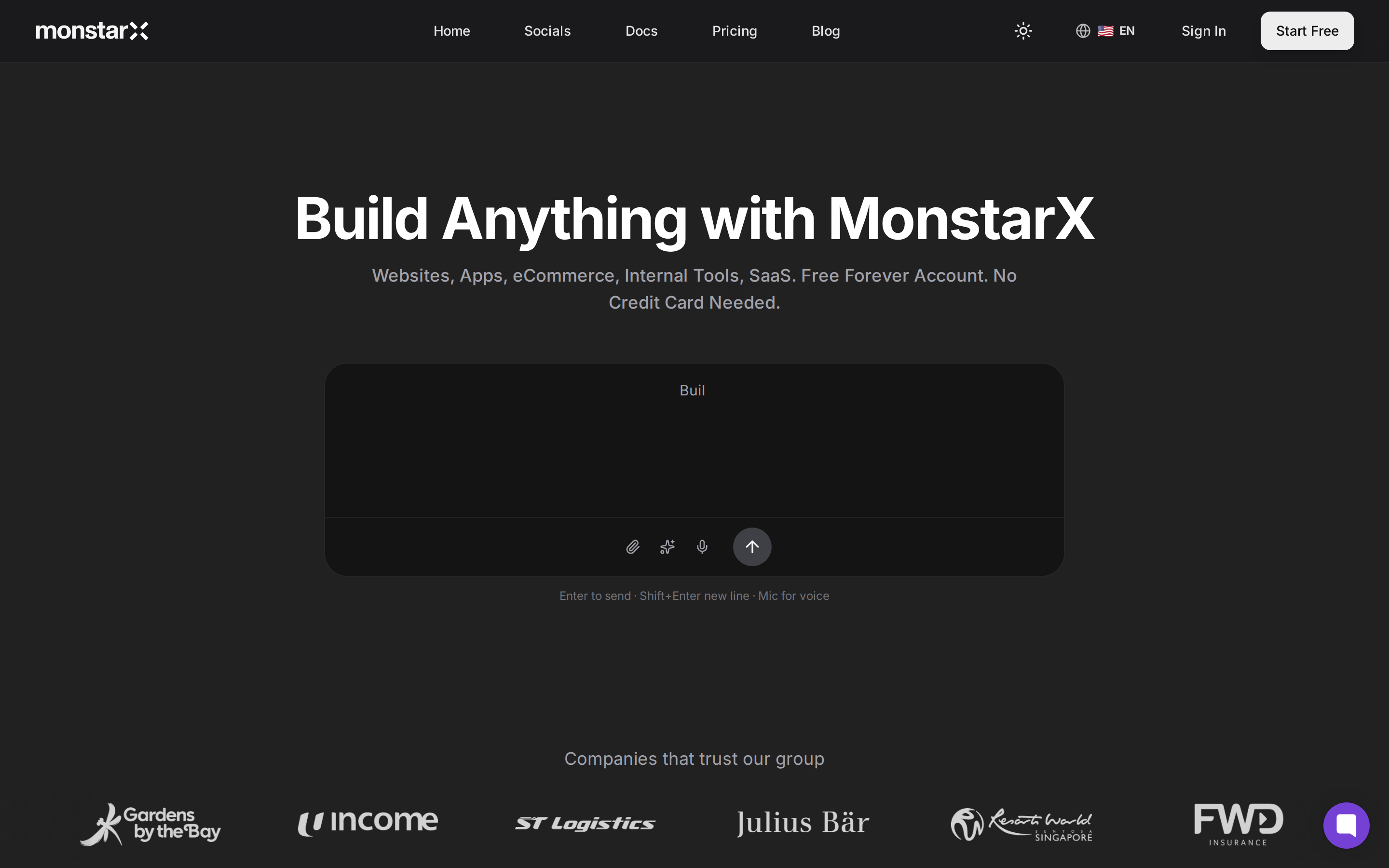
MonstarX wasn't built to compete with v0 directly — they target different lifecycle phases. Where v0 produces production UI components, MonstarX produces stakeholder-approved prototypes plus the requirements documentation needed to actually build them. The multi-agent architecture maps directly to how enterprise prototyping actually works: requirements agent surfaces the questions a senior PM would ask, architecture agent maps to engineering templates, code generation agent produces scaffolding for the engineering team to take over.
The platform's pre-built connectors include Asian payment systems like Alipay, WeChat Pay, LINE Pay, GrabPay, and GoPay — first-class integrations rather than afterthoughts. v0 doesn't have equivalent regional support. For teams building for Southeast Asian or East Asian markets, those integrations save weeks of custom work that would otherwise be billable engineering time.
For Asian enterprises specifically, MonstarX's structural fit covers the gaps v0 doesn't address: multi-agent workflow for non-technical users, engineering handoff support for production builds, private deployment options for data sovereignty, regional integrations for local payment and logistics services. v0 is the right tool when a developer needs polished UI components. MonstarX is the right tool when a non-technical PM needs a complete prototype with documentation. Different jobs.
What This Means for Asian Developers and Product Teams
The interesting 2026 pattern in enterprise teams across Asia isn't picking one tool — it's combining them. Use MonstarX for stakeholder alignment and the spec phase; hand the approved brief to a developer running v0 for UI implementation in your codebase. The combined-stack approach gets you fast stakeholder alignment from MonstarX plus production-grade UI components from v0. Neither tool tries to be the other, and the handoff works because they optimize for complementary phases of the lifecycle.
For founders, this combined approach matters because competitive moats based purely on shipping speed are eroding. Both v0 and MonstarX have collapsed iteration time at their respective phases. What remains is domain expertise, distribution, and execution discipline. The platforms can't generate those for you — they can only remove the friction that previously consumed your team's time on the parts they can automate.
For developers in regulated industries — financial services in Singapore, healthcare in Japan, government work in Indonesia — MonstarX's private/on-prem deployment plus no-training-on-customer-data guarantee solves problems v0 doesn't address at any tier. v0's strength is UI quality for code-owning developers; it's not a fit for buyers requiring data sovereignty. The two platforms aren't competitors — they're tools for different audiences.
Frequently Asked Questions
Isn't v0 full-stack now?
Partially. The February 2026 update added DB connectivity and agentic workflows, pushing v0 beyond pure UI generation. But v0's strength is still UI — the component code quality is the best in the category, and that's what most users come for. Full-stack capabilities are functional but not as polished as UI generation. For complex full-stack apps, dedicated full-stack platforms like MonstarX or Lovable are better fits. v0 makes sense as a UI specialist that's expanding into adjacent capabilities, not as a complete replacement for full-stack tools. The honest answer is that v0 is best at what it was originally designed for, and the full-stack additions are useful but secondary.
Does MonstarX produce as polished a UI as v0?
No. v0 owns UI polish in 2026. Its output uses accessible, responsive, idiomatic React + Tailwind + shadcn/ui components that pass code review with minimal cleanup. MonstarX optimizes for end-to-end consistency against engineering templates rather than pixel-perfect components. The MonstarX UI is functional and follows production patterns, but it's not optimized for the design fidelity v0 specializes in. If your priority is shipping polished UI to production, v0 is the right tool. If your priority is a complete prototype with requirements documentation, MonstarX is the right tool. Different priorities, different platforms.
Can I use both MonstarX and v0 together?
Yes, and this is increasingly common in 2026 enterprise teams. Use MonstarX to align stakeholders on requirements and architecture — capturing the brief, agreeing on the approach, generating the spec — then hand a tight UI brief to a developer running v0 for component implementation in your codebase. The two platforms have complementary strengths: MonstarX excels at structured intake from non-technical users, v0 excels at polished UI code for developers. The handoff works because Monstarlab's templates produce structured output that translates cleanly into v0's prompt format. For teams operating across both non-technical and technical user personas, this combined approach captures the best of both platforms.
Which is cheaper in practice?
MonstarX flat $20/mo is cheaper than v0 Premium $20/mo (credit-based) for repeated full-stack prototype iterations. v0's credit system stretches fine for UI work but burns fast on agentic workflows and DB connections — particularly post-Feb 2026 when those features launched. For teams running 4-5 prototype iterations per week, MonstarX's flat structure compounds to material savings across a year of usage. For UI-only work where credits stretch further, v0's pricing is competitive. The honest comparison depends on what you're actually generating — credits scale with output complexity, and full-stack output is more expensive than UI components.
The April 2026 surge in MonstarX comparison content reflects a category where the right tool depends entirely on your job. v0 is the right tool when a developer needs polished UI components. MonstarX is the right tool when a non-technical PM needs a complete prototype with documentation. They're not competitors — they're complementary tools for different parts of the product lifecycle. For Asian enterprise teams in 2026, the smart move is using both: MonstarX for intake, v0 for build-out. Pick based on phase, not feature checklists.