
The Best Emergent.sh Alternative in 2026 Is Not What You'd Expect

By Kristine Ling · June 19, 2026 · 8 min read
I landed on MonstarX because Emergent.sh did not finish my build.
That is the short version. The longer version is that I sat in front of the same prompt for the better part of an afternoon, watching credits drain while the builder looped, hitting "Error Waking Up Agent" twice, and eventually accepting that the thing I wanted to ship was not going to come from that tool on that day.
I was not alone. The feedback on Emergent's Trustpilot page and across Reddit's vibe coding communities tells the same story: the promise is real, the results are inconsistent, and the credits disappear faster than the output justifies. One user on Reddit summarised it directly: "Credits burn way too fast, even for small tasks, usage shoots up unexpectedly." (Source)
So I went looking for something that would actually take the same idea I had typed into Emergent and turn it into a working product. What I found was MonstarX, and the difference was significant enough that I want to walk through it properly here.
What Emergent.sh Gets Right
I want to be fair about this before I get into the comparison, because Emergent is genuinely appealing for specific things.
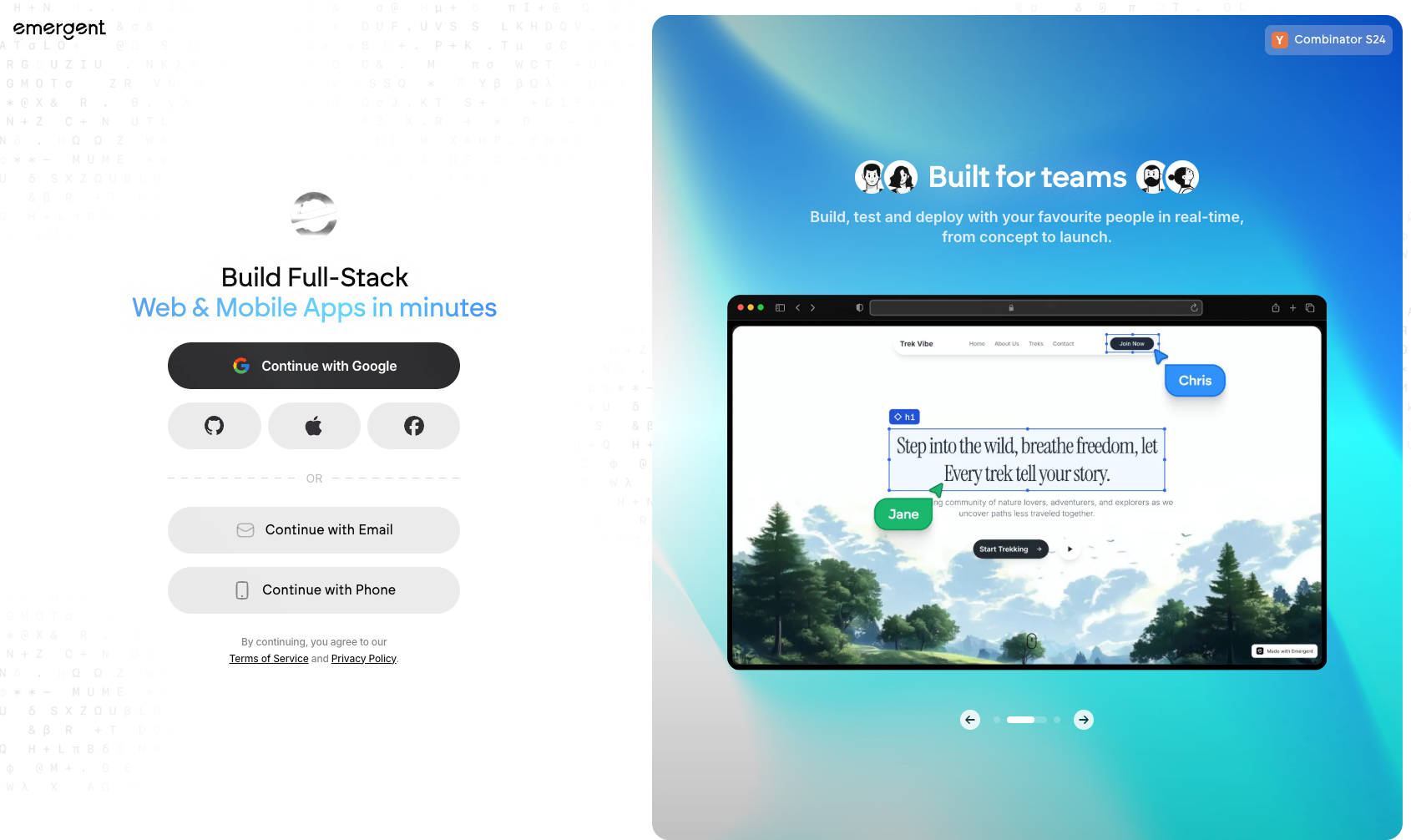
For fast UI mockups and surface-level layouts, it is quick and capable. The idea of describing a product in plain language and watching something take shape is real and it works, at least for the first few layers. If all you need is a rough visual to show someone else, Emergent can get you there.
The frustration starts when the project gets more complex. Editing becomes risky. One change can trigger a full rebuild. The AI does not always understand what it already built well enough to update just the part you asked about. And that credit burn compounds fast once you are in fix-this-again cycles rather than making forward progress.
That is the gap MonstarX closes.
Why MonstarX Is the Emergent Alternative Worth Using
It starts differently
The first thing MonstarX does before generating anything is ask what you actually want to build.
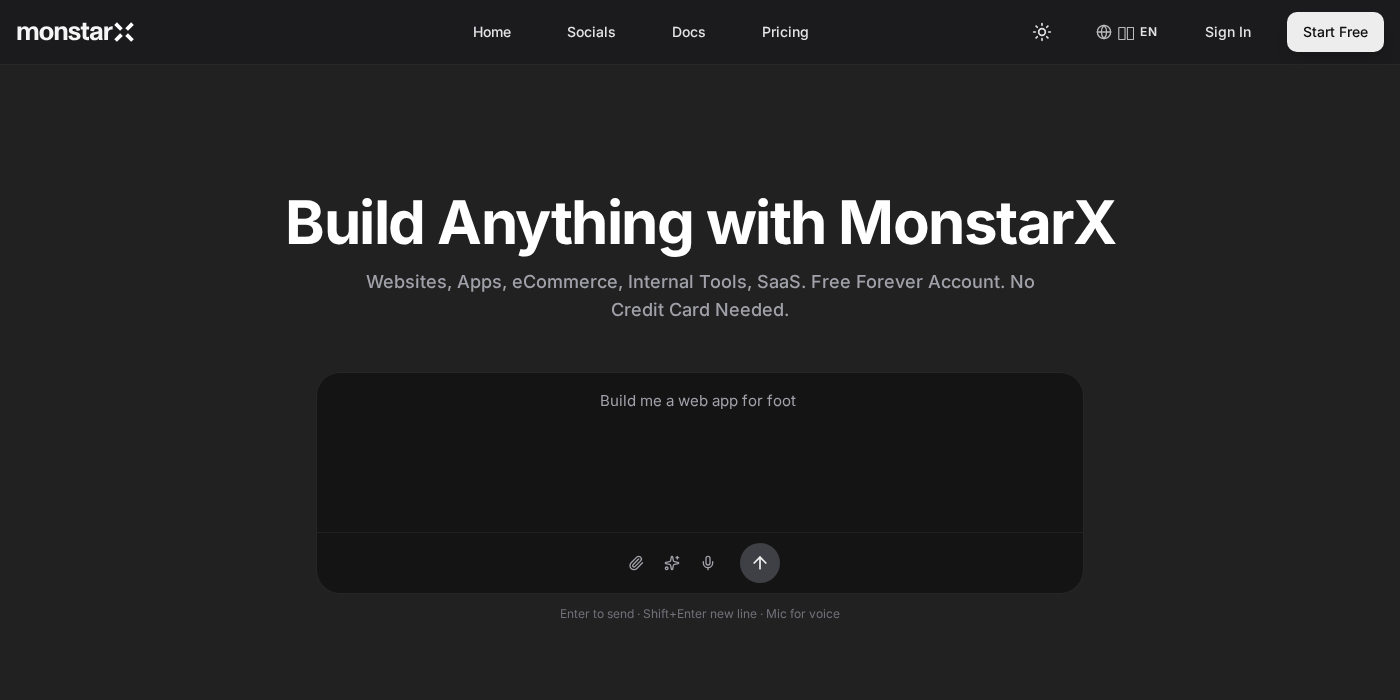
Not in a vague way. The scope selector is specific: is this a marketing website, do you want authentication included, do you need a full application, do you need an admin dashboard as well? Each choice produces a structurally different output. A marketing site is different from a full-stack application with user accounts and a database, and the tool treats them differently rather than making assumptions that cost you time later.
Most AI builders, Emergent included, take your prompt and start building. MonstarX takes your prompt and makes you clarify the scope first. That single step prevents the most common failure mode in this category.
After the scope selection, MonstarX clarifies your idea before a single line is written. It lists every page it plans to build, the visual direction, the authentication flow, any technical considerations specific to your product type. You can edit it before the build starts. In practice, if you have described your product clearly, you probably will not need to.
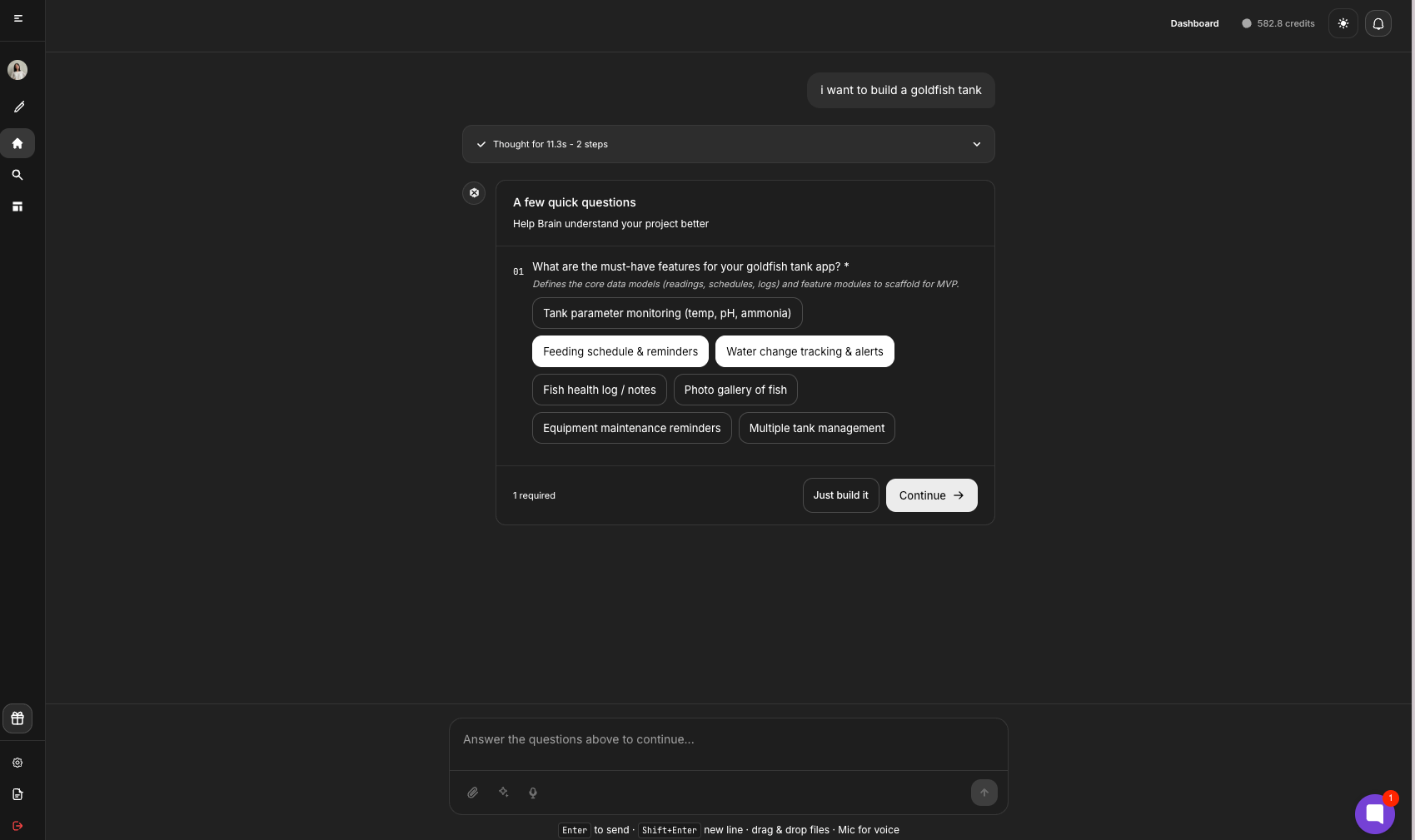
This is the thing I kept coming back to when comparing the two tools. Emergent starts generating quickly. MonstarX starts building correctly. For a prototype you want to show someone, speed matters. For a product you want to actually use, correctness matters more.
It builds the full stack, not just the front
One of the less obvious limitations of Emergent is that the backend is largely your problem. It can produce UI, but connecting real data, authentication, and external services requires either additional configuration or a separate tool.
MonstarX generates the complete application in one pass. Frontend, backend, database schema, authentication flow. You describe the product and the backend is not a separate decision you make afterward.
The Connectors tab is where this becomes particularly practical. Every external service your application needs, Stripe for payments, Twilio for SMS, Resend for email, Google Maps, Google Analytics, and AI APIs from Anthropic and OpenAI, lives in one place. You paste in your API key and the connection is handled. No documentation reading. No manual integration work. For a non-technical founder, this is the difference between a demo and a deployable product.
If you have been reading our other posts, you have seen this come up in the MonstarX review and in the Plank build writeup. The Connectors tab is consistently the feature that changes what the tool is capable of for real businesses.
The phased build prevents the rebuild loop
Emergent's editing problem, where a single change can trigger a full rebuild, comes from the fact that the AI is not working from a stable, structured plan. It is improvising as it goes.
MonstarX builds in phases. Phase one completes before phase two starts. When each phase finishes, the tool tells you what it built and asks whether to continue. If something looks wrong at phase two, you catch it before phases three, four, and five have been built on top of a mistake.
That checkpoint system is what makes iteration feel safe rather than risky. You are not hoping the AI understood your correction correctly. You are approving each stage before the next one begins.
Mobile is not an afterthought
Emergent generates web apps. If your product needs to run on a phone, Emergent has no answer.
MonstarX generates native iOS and Android apps from the same prompt that builds your web application. This is not a web app wrapped in a mobile shell. It is actual native mobile output. For any founder building a product that needs to live on a device rather than a browser, this is a structural difference that no other major AI builder currently matches.
If you are weighing your options on this specifically, the AI web app builders comparison goes into more detail on where each tool stands on mobile support.
The free plan is actually usable
Emergent's credit system is one of the most-cited frustrations in the community. Credits drain fast, and once they are gone you are either waiting or paying.
MonstarX gives you three credits every day, resetting every 24 hours. Not a monthly cap that runs out in the first week. Three credits, every morning. If you are building something real over several weeks, which is how most actual products get made, that daily reset is considerably more predictable than a large one-time allocation you burn through in one afternoon.
The paid plan starts at $13 per month for the Solo tier, which is also lower than Emergent's paid options. If you want a detailed breakdown of how the pricing stacks up across AI builders, the non-technical founders guide has the full comparison.
Emergent vs MonstarX: Side by Side
| Emergent.sh | MonstarX | |
|---|---|---|
| Backend auto-generated | Partial | Yes, full stack |
| Mobile app output | No | Yes (iOS + Android) |
| Scope selector before build | No | Yes |
| PRD before generation | No | Yes |
| Phased builds with checkpoints | No | Yes |
| External service connectors | Limited | Yes (Stripe, Twilio, OpenAI, etc.) |
| Free plan | Yes (credit-based) | Yes (3 credits/day, daily reset) |
| Starting paid price | Higher | $13/mo (Solo) |
| Edit stability | Inconsistent | Stable, phase-controlled |
| Best for | Quick mockups | Full product from idea to deployed |
When Emergent Is Still the Right Choice
I want to be honest about this rather than give you a one-sided comparison.
Emergent is worth using when the goal is a quick visual prototype and nothing more. If you need to show a stakeholder what a product could look like, or validate an idea in the fastest possible way without caring about the backend or edit stability, Emergent can get you to that screenshot in less time than MonstarX will.
The limitation is that the gap between "Emergent prototype" and "product someone can use" is large. MonstarX narrows that gap significantly, but it also means the build takes a bit longer because it is doing substantially more work.
If you are evaluating which tool fits your current stage, the honest question is: are you building something to show, or something to ship? For showing, Emergent is fine. For shipping, MonstarX is the better starting point.
What I Would Tell Someone Making the Switch
If you are coming from Emergent and trying MonstarX for the first time, a few things will feel different.
The scope selector at the start is not a delay. It is the step that makes everything after it more reliable. Take the time to answer it specifically.
The PRD that appears before the build is worth reading. It will tell you if the system has understood your product correctly. If something looks off, edit it before the build starts rather than after.
The phased build is slower than Emergent's approach but produces something you can actually iterate on. Each phase completing cleanly is worth more than one fast generation that breaks when you try to change anything.
And the Connectors tab is where MonstarX becomes a real business tool rather than a demo. Do not skip it.
If you want to see what a complete build looks like from start to finish, the hair salon demo walkthrough covers the full process with specifics on each stage.
Frequently Asked Questions
Is MonstarX better than Emergent.sh? For building a full product you intend to ship, yes. MonstarX generates the backend automatically, supports mobile app output, uses phased builds that prevent rebuild loops, and includes a Connectors tab for integrating services like Stripe and Twilio without manual configuration. For quick mockups where only the UI matters, Emergent is faster.
What makes MonstarX different from Emergent? Three structural differences matter most. MonstarX uses a scope selector and PRD before building, so it builds the right thing rather than what sounds right. It generates the full stack including the backend, not just the frontend. And it builds in phases with checkpoints, so editing one thing does not break everything else.
Does MonstarX have a free plan? Yes. MonstarX gives you three credits per day on the free plan, resetting every 24 hours with no credit card required. The paid Solo plan starts at $13 per month. Both are significantly cheaper than Emergent's paid tiers for what you get.
Can MonstarX build mobile apps? Yes. MonstarX generates native iOS and Android apps from the same prompt that produces your web application. Emergent generates web apps only.
How long does it take to build something real in MonstarX? A complete marketing site can be generated in under ten minutes. A full-stack application with authentication, a database, and an admin dashboard runs in phased stages, each completing before the next begins. The total time depends on scope, but the phased approach means you are reviewing real output rather than waiting for a long single generation to complete.
What happens if I want to connect Stripe or other services? The Connectors tab in MonstarX lists every supported external service. You add your API key and the connection is handled without any manual integration work. This covers Stripe, Twilio, Resend, Google Maps, Google Analytics, and AI APIs from Anthropic and OpenAI.
Is MonstarX suitable for non-technical founders? Yes. It is specifically designed for people who are not developers. The scope selector, PRD, and phased builds are all structured to guide you through the decisions that matter without requiring technical knowledge to make them. For a more detailed walkthrough, the non-technical founders guide covers the full picture.