
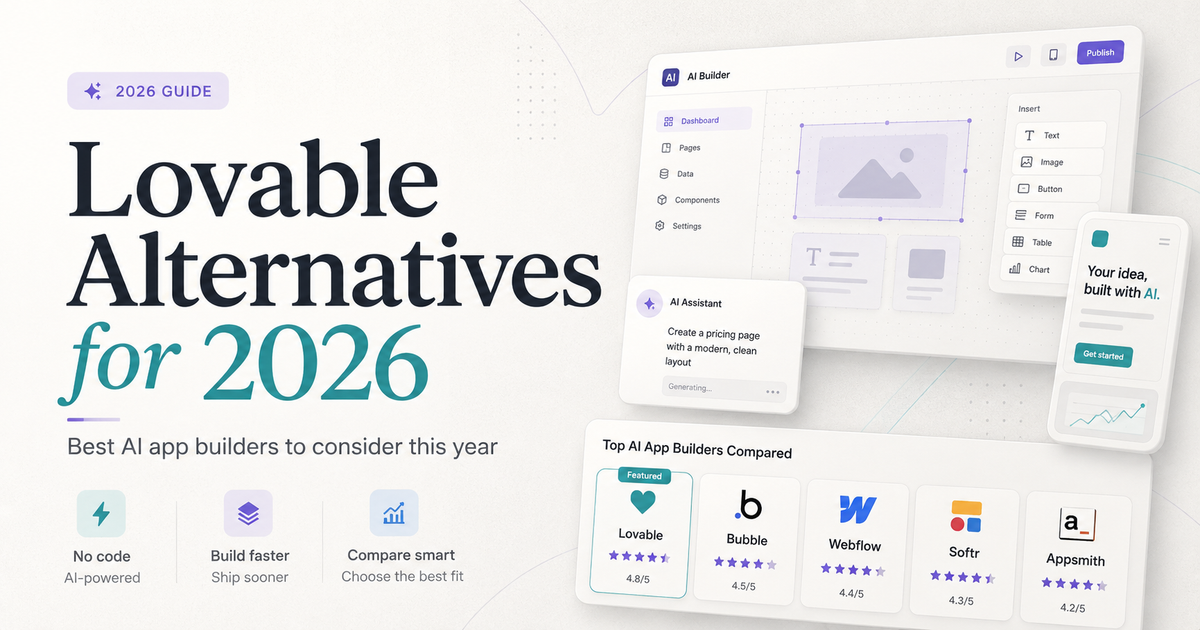
Lovable Alternatives for 2026

By Kristine Ling · July 14, 2026 · 9 min read
I want to give Lovable its credit before I say anything else. When I first used it, I was genuinely surprised. I described a product in plain language, and within a few minutes I had something I could click through and show people. That speed is real, and it matters.

But if you are here comparing MonstarX and Lovable, you are probably past that first impression. You are thinking about what happens after the demo. The backend that needs to be connected. The Stripe integration that is not wired up. The mobile version that does not exist. The edit you made that somehow broke three things you did not touch.
That is where this comparison actually lives.
The Short Version
Lovable is the right tool when your priority is getting a working web prototype in front of someone as fast as possible. It is fast, the iteration loop is tight, and the community is mature.
MonstarX is the right tool when you want a complete product. Not a prototype you will rebuild later. A product with a real backend, real integrations, real mobile output, and a build process that does not break when you try to change something.
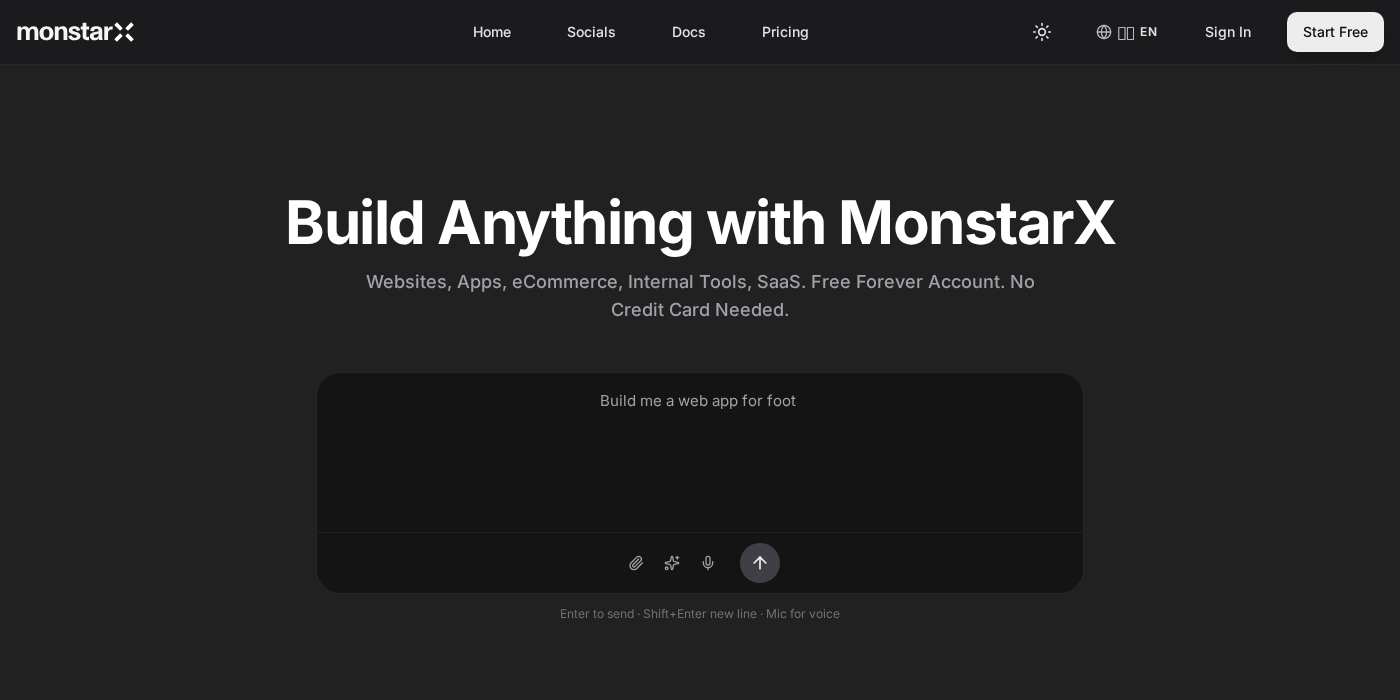
The question is not which one is better. The question is what you are actually trying to build.
| Lovable | MonstarX | |
|---|---|---|
| Best for | Fast web prototyping, early-stage demos | Complete product from idea to deployed, web + mobile |
| Editing model | Prompt-first, visual edits for UI polish | Scope selector + PRD before build, phased generation |
| Backend | Supabase auto-generated | Full stack: frontend, backend, DB schema, auth in one session |
| Mobile output | Web only | Native iOS + Android from the same prompt |
| External integrations | Limited | Stripe, Twilio, Resend, Google Maps, AI APIs via Connectors tab |
| Edit stability | Inconsistent on larger changes | Stable, checkpoint-controlled by phase |
| Free plan | 5 daily credits (30/month) | 3 credits/day with daily reset |
| Starting paid price | $25/month | $13/month (Solo) |
| Best when | You want to validate an idea quickly | You want to move from prototype to shipped product |
Different Tools for Different Stages
The WeWeb team wrote something similar recently that framed this well: getting started is one thing, and refining the experience while maintaining control over every detail is something else. That framing is accurate and it applies here too.
Lovable is genuinely good at the first stage. The loop from prompt to running application is one of the fastest in the market right now. The visual editing tools for UI polish are clean. The automatic Supabase integration means you are not starting completely from scratch on the backend. For a first version, for validation, for a demo you need in 48 hours, Lovable does its job.
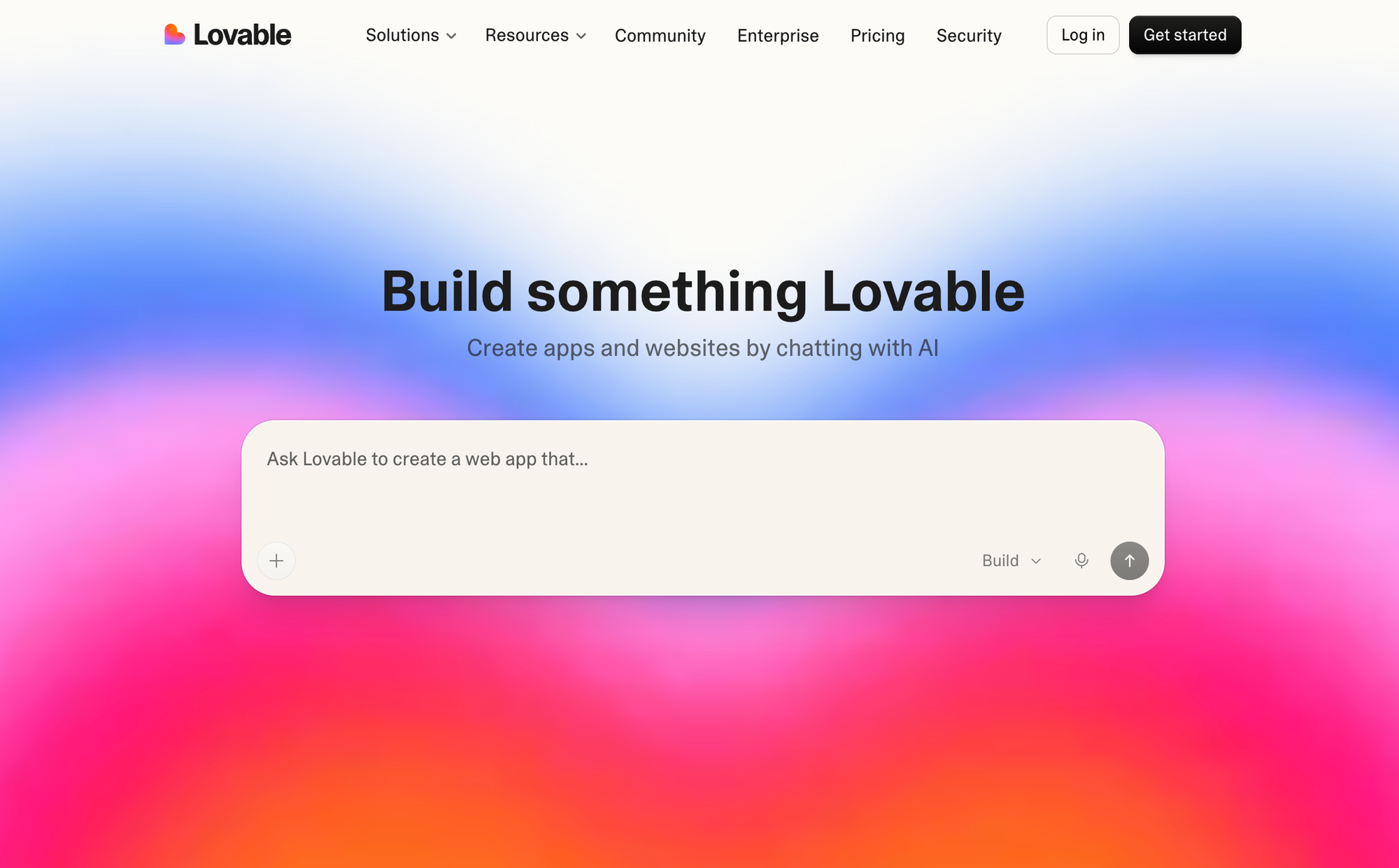
The friction starts at stage two. When the product needs to connect to a payment processor. When a user on mobile needs the same experience the web user has. When you want to change one specific thing and instead you get a rebuild that touches five others. Lovable was not designed for those problems, and it shows.
MonstarX was designed for exactly those problems.
Why the Build Starts Differently
The first thing MonstarX does before generating anything is ask what you are actually building.
The scope selector is specific: is this a marketing site, a full application with user accounts, something that also needs an admin dashboard, does it need authentication? Each answer changes the architecture the tool produces. A marketing site is structurally different from a multi-user SaaS product, and the tool treats them differently rather than making assumptions you discover later.
After scope, MonstarX generates a Product Requirements Document before writing a single line of code. You read it, confirm the system understood your product, and only then the build begins. In practice, if you described your product clearly, you mostly just confirm and continue. What you get from that step is confidence that the next four phases are building the right thing.
Most AI builders, including Lovable, take your prompt and immediately start generating. MonstarX takes your prompt and makes you clarify the scope first. That single step prevents the most common failure mode in this category: discovering at phase five that the AI built something structurally wrong and the only path forward is starting over.
The Backend Is Not a Separate Project
Lovable generates a frontend and connects it to Supabase. That is genuinely useful, and for web applications with straightforward data requirements, it is often enough.
MonstarX generates the complete application from a single description. Frontend, backend, database schema, and authentication flow in one session. The backend is not something you configure separately after the frontend looks right. It is part of the first output.
The Connectors tab is where this becomes a business tool rather than a demo. Every external service the product needs, including
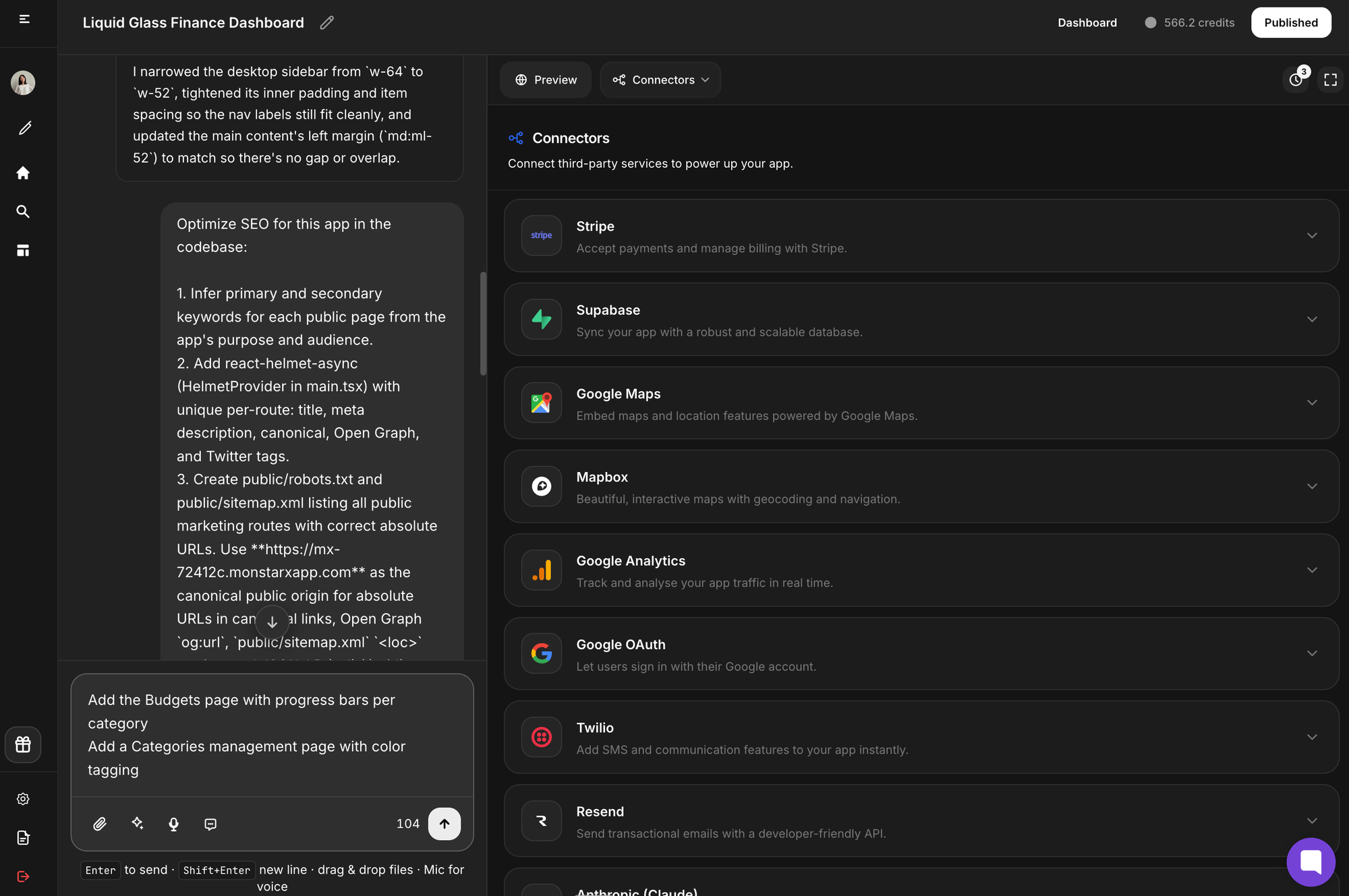
Stripe for payments, Twilio for SMS, Resend for email, Google Maps, Google Analytics, and AI APIs from Anthropic and OpenAI, is available in one place. You add an API key and the integration is handled. No documentation reading. No manual wiring. No separate project for every service you need to talk to.
Lovable works primarily with Supabase as the backend layer. If your product needs Stripe connected, you are doing that separately. If you need to send an email from the application, you are handling that too. The Connectors tab is the difference between a prototype that demonstrates what the product does and a product that actually does it.
For a full walkthrough of what this looks like on a real build, the Plank full-stack build post shows the Connectors tab in action with a product that processes real data.
Prompt Purgatory Is a Real Problem
There is a failure mode that everyone who has spent serious time in any AI builder eventually hits: you are trying to change one specific thing, the AI interprets the prompt slightly differently than you intended, something else breaks, you prompt again to fix it, that breaks something else, and you are now forty minutes deep into fixing a problem that should have taken five minutes.
WeWeb describes this as "prompt purgatory" and the framing is accurate. Lovable's editing model is prompt-first, which means every change you want to make goes through the same generation loop. For early iteration when the product is still taking shape, that loop is fast and satisfying. For precise, targeted changes on a product that is already working, it is frustrating.
MonstarX addresses this through phased builds. The application is built in phases, each completing before the next begins. At the end of each phase, MonstarX reports what it built and asks whether to continue. If something looks wrong at phase two, you catch it before phases three, four, and five are stacked on top of it. You are not hoping the AI interpreted your correction correctly. You are approving each stage before the next one starts.
That checkpoint model is what makes editing feel safe rather than risky. It is also what makes MonstarX builds more stable on larger changes, where Lovable's prompt-first approach tends to produce inconsistent results.
Mobile Is Not Optional Anymore
This is the part of the comparison that is most straightforward: Lovable builds web applications. If your product needs to run on a phone, Lovable does not have an answer.
MonstarX generates native iOS and Android apps from the same prompt that builds the web application. This is not a web app wrapped in a mobile shell. It is actual native mobile output. For any founder building a consumer product where most users will be on their phones, this is not a minor feature difference. It is a structural difference in what each tool can produce.
If mobile is part of your product requirement, that conversation ends here. The
AI web app and mobile builder comparison goes into more detail on the mobile output landscape, and MonstarX is the clear answer for native mobile output alongside web.
Design Freedom: Where Each Tool Gives You Control
Lovable's UI output looks good out of the box. The AI-generated layouts are polished and the visual editing tools let you handle the last mile of UI polish without going through the prompt loop every time. For pure frontend presentation work, Lovable is strong.
The limitation is what happens when you want to change something specific and structural, not just visual. At that point, you are either prompting your way to the change or editing the underlying code. Neither is as fast as having the structure right from the start.
MonstarX builds from a confirmed specification, which means the first version is more likely to be architecturally correct. The tradeoff is that the initial build takes slightly longer, because it is doing the scope selection and PRD step before generating. For teams where "fast to first screenshot" is the priority, Lovable wins that specific race. For teams where "right the first time" matters more, MonstarX wins the build.
For a deeper comparison of how both tools fit into different use cases and at different stages of a product, the best AI coding tools by use case post covers the full picture.
Getting to Production
Both tools let you work toward a deployable product. The path looks different.
With Lovable, you prototype in the builder, push to GitHub when you want to take the project further, and handle your own environments, CI, and deployment setup from there. The bi-directional GitHub sync is useful for teams that want to graduate a Lovable project into a professional engineering workflow. The limitation is that once you leave the Lovable environment for something Lovable cannot handle, the platform is not helping you anymore.
With MonstarX, you build the complete product, including the backend, in one session. Deployment comes from there. You are not leaving a separate phase of configuration for later, because the configuration happened as part of the build. For a non-technical founder who wants the path from "prompt to live product" to be as short as possible, this is the more direct route.
The building an app in under 10 minutes post shows what the full MonstarX build looks like from scope selection to published product.
The Honest Bottom Line
Lovable is for fast web prototyping. It is the right tool if you want to validate an idea in 24 hours, show a stakeholder what a product could look like, or get something in front of users quickly to learn from it. The community is large, the documentation is good, and the iteration loop is one of the fastest available.
MonstarX is for building the product. It is the right tool if you need web and mobile from the same build, if your product needs to connect to external services, if you want a backend that is generated automatically rather than configured separately, and if you want a build process where you approve each phase before the next one begins rather than hoping the prompt loop interpreted your intent correctly.
For most early-stage founders, the most efficient path is: validate the idea with Lovable or a simple prototype, then build the real product in MonstarX. If mobile is part of the requirement from day one, that sequencing changes and MonstarX is the starting point.
The future of software post gets into what it actually means to build a product without a developer in 2026, and how the ceiling on what non-technical founders can ship keeps moving upward.
Frequently Asked Questions
Is MonstarX better than Lovable? It depends on what you are building. For pure web prototyping speed, Lovable is faster to a first version. For a complete product that includes a backend, external service integrations, and native mobile output, MonstarX is the more capable tool. Most founders who make the switch do so because they hit Lovable's limits, usually around mobile output, backend configuration, or edit stability on complex changes.
Can MonstarX replace Lovable? For most production use cases, yes. MonstarX covers what Lovable covers and adds native iOS and Android output, a scope selector and PRD before building, phased checkpoints that prevent rebuild loops, and a Connectors tab for integrating Stripe, Twilio, and AI APIs without manual configuration. For web-only rapid prototyping, Lovable's community and iteration speed are still advantages.
What is the main difference between MonstarX and Lovable? Three structural differences matter most. MonstarX defines scope before building, so it builds the right architecture rather than what sounds right. It generates the full stack automatically including the backend, not just the frontend connected to Supabase. And it builds in phases with checkpoints, so editing one thing does not break everything else. The fourth difference is mobile: MonstarX generates native iOS and Android apps, Lovable does not.
Does Lovable have a free plan? Yes. Lovable gives you 5 daily credits, which equals 30 per month. MonstarX gives you 3 credits per day with a daily reset, which is more predictable for active building over several weeks.
Can non-technical founders actually build with MonstarX? Yes. The scope selector, PRD generation, phased builds, and Connectors tab are designed specifically for people who are not developers. You describe what you want, confirm the system understood you, and approve each stage before it continues. No backend decisions. No manual configuration. The non-technical founder build walkthrough shows what this looks like in practice with a real product.
What happens when I need Stripe or Twilio in Lovable? You handle it separately, either through manual code integration or a workaround. In MonstarX, both are available in the Connectors tab. You add the API key and the connection is handled. The same applies to Resend for email, Google Maps, Google Analytics, and AI APIs from Anthropic and OpenAI.
Is MonstarX right for SaaS products? Yes. The scope selector distinguishes between a marketing site and a full application with user accounts and an admin dashboard. If you are building a SaaS product, MonstarX builds the authenticated multi-user application structure automatically, including the database schema, the authentication flow, and the admin view. The 7 best Lovable alternatives post covers the specific use cases in more detail.
Related Reading
- How I Built a Full-Stack AI App With a Real Database and No Engineering Team
- Building an Application in Less Than 10 Minutes Without Code
- 7 Best Lovable Alternatives in 2026 Compared by Use Case
- 12 Best Lovable Alternatives for Different Use Cases 2026 Edition
- Best Bolt AI Alternatives for Building Your Mobile App in 2026
- The Best Emergent.sh Alternative in 2026 Is Not What You'd Expect
- The Future of Software Will Be Built by Non-Engineers
- Debugging in the Era of Vibe Coding