
The Best Lovable Alternatives in 2026 (When Your Prototype Needs to Launch)


By Kristine Ling · July 2, 2026 · 11 min read
The thing that makes Lovable so addictive is the loop. You prompt, see a running app, iterate, refine the UI with visual tools, and repeat. It is one of the fastest ways to go from a thought to something you can click through. For that specific phase of a project, there is almost nothing better.
The problem is that most people looking for a Lovable alternative are looking because they succeeded at Lovable. The prototype worked. People want to use it. And now the questions start: how do I add mobile? How do I connect Stripe without reading API documentation? How do I take this to a real codebase when the project gets serious?
This guide covers where to go depending on the specific thing Lovable did not give you.
The Quick Answer
| Tool | Best for | Mobile | Backend auto | Starting price |
|---|---|---|---|---|
| MonstarX | Full-stack + mobile, non-technical builders | Yes (iOS + Android native) | Yes | $13/month |
| Lovable | Fast web prototyping, GitHub sync | No | Yes (Supabase) | $25/month |
| Bolt.new | Framework flexibility, Angular, React Native | Partial (React Native) | Yes (Supabase) | $25/month |
| v0 by Vercel | React UI components, Vercel teams | No | Partial | $20/month |
| Replit Agent | Browser-based dev environment with full AI context | No | Self-managed | $25/month |
| Bubble | Complex web apps, custom logic without code | No | Yes | $32/month |
| Cursor | Professional development, existing codebases | No | Self-managed | $20/month |
| Windsurf | Context-aware professional coding | No | Self-managed | $15/user/month |
If Lovable Is Missing the Features You Actually Need
MonstarX
MonstarX is what I recommend when someone has outgrown Lovable or realises they need things Lovable was never designed to provide.
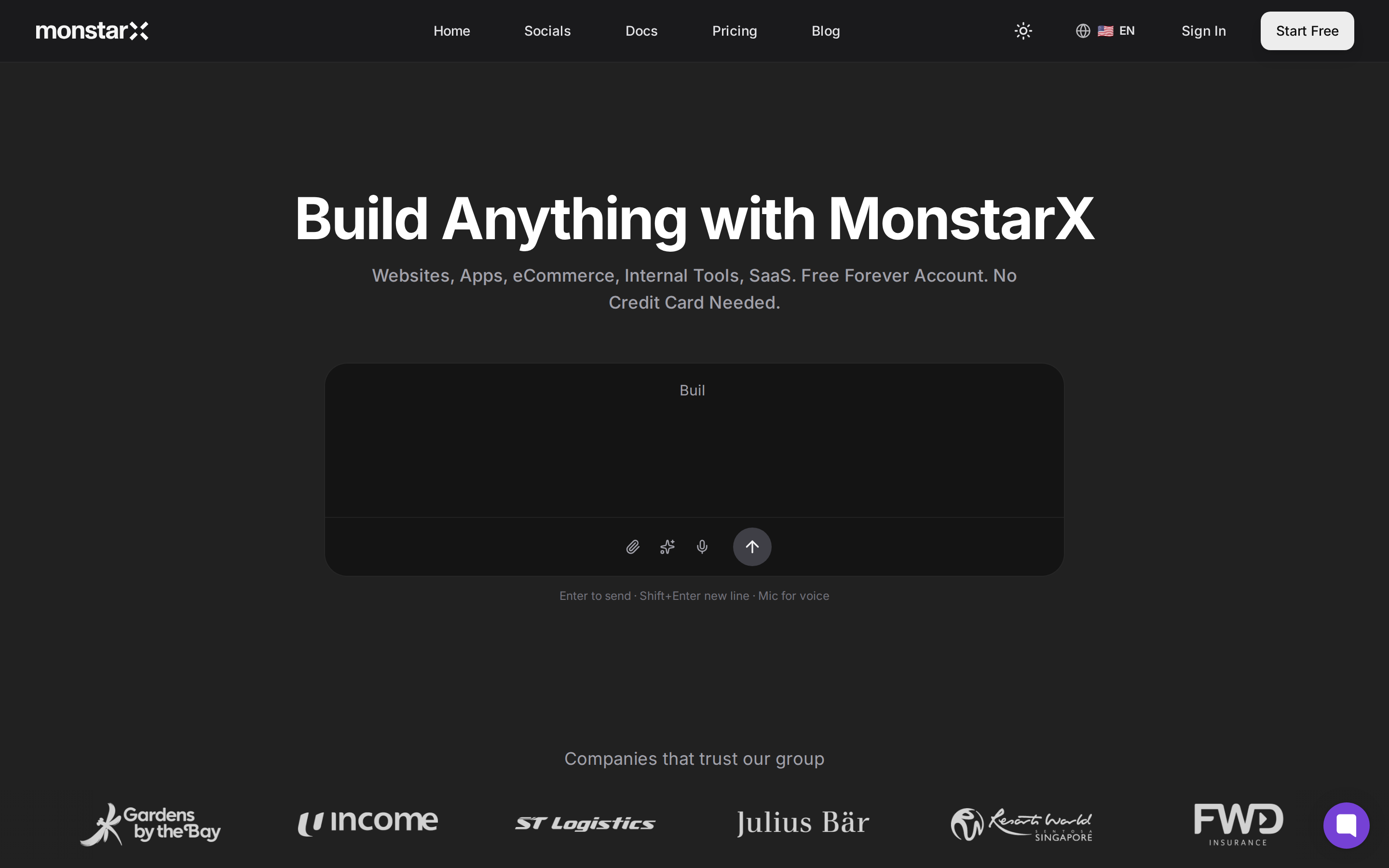
The core difference is scope. Lovable optimises for speed to a working web prototype. MonstarX optimises for completeness: what do you actually need to build a product that works, integrates with real services, and runs on a phone.
Before generating anything, MonstarX asks you to select the scope of your build. Is this a marketing site? A full application with authentication? Does it need an admin dashboard? That question sounds minor but it determines the entire architecture, and getting it right before the build starts prevents the most painful failure mode in AI building: discovering at phase five that you built on the wrong foundation.
After scope, MonstarX generates a Product Requirements Document. You read it, confirm the system understood your product, and only then the build begins. It runs in phases, each completing and checking in before the next starts. If something is wrong at phase two, you catch it before it is buried under four more phases.
The backend is not a separate project. MonstarX generates frontend, backend, database schema, and authentication automatically from the same description. The Connectors tab is where this becomes a business tool rather than a demo: Stripe, Twilio, Resend, Google Maps, Google Analytics, and AI APIs from Anthropic and OpenAI are all there. You add an API key and the integration is handled. No documentation. No manual wiring.
The feature Lovable genuinely cannot match: MonstarX generates native iOS and Android apps from the same prompt that builds the web application. If your product belongs on a phone, this is the only major AI builder in 2026 that handles it natively. The best Bolt AI alternatives for mobile post runs through the full landscape if you want to compare options, and MonstarX comes up as the clear answer for native mobile output.
The free plan is three credits per day, resetting every 24 hours. The paid Solo plan starts at $13 per month. For a complete walkthrough of what a MonstarX build looks like from start to finish, the full-stack app build post covers the specifics.
Best for: Non-technical founders, product managers, and anyone who needs web plus mobile output from a single build, with backend and external service integrations handled automatically.
Pricing: Free (3 credits/day, daily reset), Solo $13/month, Pro $20/month, Teams $59/month
If You Want the Same Speed as Lovable, Different Workflow
Bolt.new
Bolt.new is the closest functional equivalent to Lovable if you want a browser-based builder with more code visibility and framework flexibility.
Where Lovable and MonstarX have a preferred stack, Bolt can scaffold in React, Angular, Vue, and React Native. If you have a specific framework requirement, Bolt is often the only browser-based tool that handles it. The build quality has improved significantly in 2026: there is now a built-in backend powered by Supabase, and the two-way GitHub sync is genuinely reliable.
The honest tradeoff is that the UX is rougher than Lovable and the error rate in generated output is higher. You will do more debugging and correcting than you would in Lovable. For someone with some technical comfort who needs framework flexibility, that is acceptable. For a complete beginner who wants the smoothest possible experience, Lovable or MonstarX is the better starting point.
Best for: Developers who need Angular, React Native, or framework-specific output, and are comfortable spending time on debugging.
Pricing: Free (limited), Pro $25/month
v0 by Vercel
v0 is not a full-product builder and it does not try to be. It is the best tool in the market for fast, clean React UI component generation, and if that is specifically what you need, nothing beats it.

The output is consistently clean React using Tailwind and shadcn/ui. The visual quality from the first pass is high without much prompting. For component-level work, landing pages, or building UI to drop into a conversation with engineers, v0 is fast and reliable.
The limitations are scope: v0 generates UI, not full applications. If you are looking for a replacement for Lovable's complete environment, v0 is not it. If you are looking for a replacement for the UI generation part of what Lovable does, v0 is the best option.
The Supabase integration has improved enough to create tables and functions directly from v0, which closes a gap that used to be a dealbreaker. But the backend support is still partial compared to MonstarX or Lovable. For a detailed comparison, the MonstarX vs v0 post covers the full picture.
Best for: React and Next.js teams who want to fast-forward through initial UI drafting and merge output directly into a real codebase.
Pricing: Free ($5 credits/month), Premium $20/month
Replit Agent
Replit is a full cloud development environment with a strong AI agent embedded in the workflow. You can prompt an app into existence, keep iterating, and deploy from the same environment, with the AI able to read and edit every file in the project. That full-context awareness produces more coherent edits than tools that can only see the current prompt.
The power is real but so is the complexity. Replit feels more like a developer environment than a builder tool. For someone who came to vibe coding to avoid dealing with code, Replit will not give them that. For someone with some technical background who wants maximum browser-based control, Replit is the strongest option available.
For a detailed look at Replit's strengths and where it falls short, the best Replit alternatives guide has the full breakdown.
Best for: Technical founders and developers who want full AI assistance inside a browser-based coding environment, with complete file-level context.
Pricing: Free (Hobby), Core $25/month
If You Want to Ship Inside a Platform
Bubble
Bubble belongs in this list because a significant portion of people looking for Lovable alternatives are actually looking for a mature visual platform that lets them build complex logic without writing code.
Bubble is the most established tool in that category. Where Lovable optimises for speed to a first prototype, Bubble goes deep on customisation through its visual programming interface. You can build genuinely complex business logic, multi-sided marketplaces, and subscription platforms without writing code. That depth is Bubble's main advantage over every AI builder in this comparison.
The tradeoff is lock-in. Moving off Bubble later means a rebuild, not an export. If your end game is a standard codebase you can take to any developer or self-host, Bubble is not the right tool. If you care more about speed to a working product with complex logic and are comfortable with the platform dependency, Bubble has a serious track record.
Best for: Solopreneurs and small business owners building complex web applications with custom workflows and logic.
Pricing: Free (learning plan), Starter $32/month, Growth $134/month, Team $349/month
If You Are Ready to Work in a Real Codebase
Cursor
Cursor is not a Lovable replacement. It is what you move to after Lovable, or after any browser-based builder, when the project has grown into something that needs a real engineering workflow.
Cursor is an AI-first code editor with strong project-wide awareness, multi-agent support for planning and refactoring across large repositories, and compatibility with any framework or language. The Agent mode for complex multi-file changes is what makes it a professional tool rather than just smart autocomplete.
The workflow that works best: prototype in MonstarX or Lovable, validate with real users, then move into Cursor once the project is serious enough to need an actual codebase and ongoing engineering investment. The debugging in the era of vibe coding post covers what that handoff looks like in practice.
Best for: Developers and technical founders who have outgrown low-code tools and want full AI assistance in a real IDE.
Pricing: Hobby (free), Pro $20/month, Business $40/user/month
Windsurf
Windsurf sits in the same category as Cursor with a different approach. Where Cursor feels like a traditional IDE with powerful AI layered on top, Windsurf takes a more opinionated flow-based approach to AI-assisted coding.
Its context-aware AI reads across files and dependencies rather than working only from the current file or prompt. The adaptive learning for individual developer style, real-time collaborative debugging, and built-in security scanning are useful for teams working on complex systems. The gap between Windsurf and Cursor is narrow enough that team preference and existing integrations matter more than raw capability differences.
Best for: Teams that want deep AI context across a professional codebase with a flow-oriented UX.
Pricing: Free (25 credits/month), Pro $15/user/month, Teams $30/user/month
What Is Actually Missing From Lovable
Lovable is a strong tool and I am not trying to argue against using it. The situation where you need an alternative is specific.
You need an alternative if your product needs to run on a phone as a native app. Lovable builds web only. MonstarX is the answer here, and currently the only major AI builder that provides native mobile output alongside web.
You need an alternative if you have framework requirements outside of Lovable's stack. Bolt.new covers Angular, Vue, and React Native use cases that Lovable does not handle.
You need an alternative if you want to move into a proper codebase for production engineering. Cursor or Windsurf are where that happens.
You need an alternative if you want more complex custom business logic baked into the visual builder layer. Bubble is the established option for that depth.
The 7 best Lovable alternatives compared by use case goes deeper on the use-case-specific decisions if you want the full breakdown. And the future of software post is worth reading if you are thinking about how far you can get with these tools before needing a developer at all.
Frequently Asked Questions
What is the best Lovable alternative for non-technical founders? MonstarX. It generates the full stack automatically, supports native mobile output, and uses phased builds with checkpoints so editing one thing does not break everything else. The Connectors tab handles Stripe, Twilio, and AI API integrations without any manual configuration. It is specifically designed for people who are not developers.
Can MonstarX replace Lovable? MonstarX does more than Lovable in several important areas: it generates native iOS and Android apps, uses a scope selector and PRD before building to prevent misbuilt foundations, and includes the Connectors tab for external service integrations. For web-only projects, Lovable's iteration loop and community are mature advantages. For anything that needs mobile or a more structured build process, MonstarX is the stronger choice.
What is the closest alternative to Lovable that keeps the same speed? Bolt.new is the most direct functional equivalent for the "prompt to running app" loop, with slightly better Git integration and framework flexibility. v0 is the closest match for raw UI generation speed but does not build full applications.
Does any Lovable alternative support mobile apps? MonstarX generates native iOS and Android apps from the same prompt that builds the web application. This is the only major AI builder in 2026 with that capability. Bolt.new supports React Native scaffolding, which is a different category of mobile output.
What happens when you outgrow Lovable? The natural next step depends on what you outgrew it for. If you need mobile, move to MonstarX. If you need a real codebase for ongoing professional engineering, move to Cursor. If you want to stay in a complete visual environment with more logic depth, explore Bubble. The Lovable alternatives by use case guide has the detailed breakdown.
Is MonstarX free to try? Yes. MonstarX has a free plan with three credits per day, resetting every 24 hours. No credit card required to get started.
Related Reading
- How I Built a Full-Stack AI App With a Real Database and No Engineering Team
- 7 Best Lovable Alternatives in 2026 Compared by Use Case
- 12 Best Lovable Alternatives for Different Use Cases 2026 Edition
- 6 Best Lovable Alternatives in 2026: Features and Pricing Compared
- MonstarX vs v0 by Vercel: Full-App Platform vs UI Generator
- Best Bolt AI Alternatives for Building Your Mobile App in 2026
- Best Replit Alternatives in 2026 That Won't Let You Down
- Debugging in the Era of Vibe Coding
- The Future of Software Will Be Built by Non-Engineers