
6 Best Rocket.new Alternatives in 2026 (Tested and Ranked)


By Kristine Ling · July 2, 2026 · 9 min read
Rocket.new has a real appeal. You describe what you want in plain language, something appears on screen, and the first few minutes feel like magic.
Then the credits run out faster than you expected. The build breaks when you try to edit something. Support takes two days to respond to a billing question. And you realise that the gap between what you built in Rocket and what you actually need is larger than the tool can close.
This is the pattern that keeps coming up in communities like Reddit's vibe coding subreddit and across review platforms: Rocket is appealing at the start and frustrating as soon as you need something real. Token usage drains faster than expected, even before meaningful features are built. Builds generate non-functional apps or crash repeatedly, forcing users into debugging loops. Customer support is inconsistent when system errors or billing issues come up. (Sources: Trustpilot, Sourceforge)
I have tested every major alternative. This is my ranked list of what to use instead, and what each tool is actually for.
What to Look For in a Rocket.new Alternative
Before getting into the tools, it is worth being direct about what Rocket's limitations actually are so you can choose a replacement that addresses the specific problem you ran into.
If your issue was credit burn, look for a tool with predictable pricing rather than token-based billing.
If your issue was builds breaking on edits, look for a tool with phased builds or checkpoint-based generation.
If your issue was the backend being your problem to figure out, look for a tool that generates the full stack automatically.
If your issue was no mobile output, there is currently only one real answer: MonstarX.
1. MonstarX
MonstarX is where I send anyone who has outgrown Rocket or hit the same wall I kept hitting.
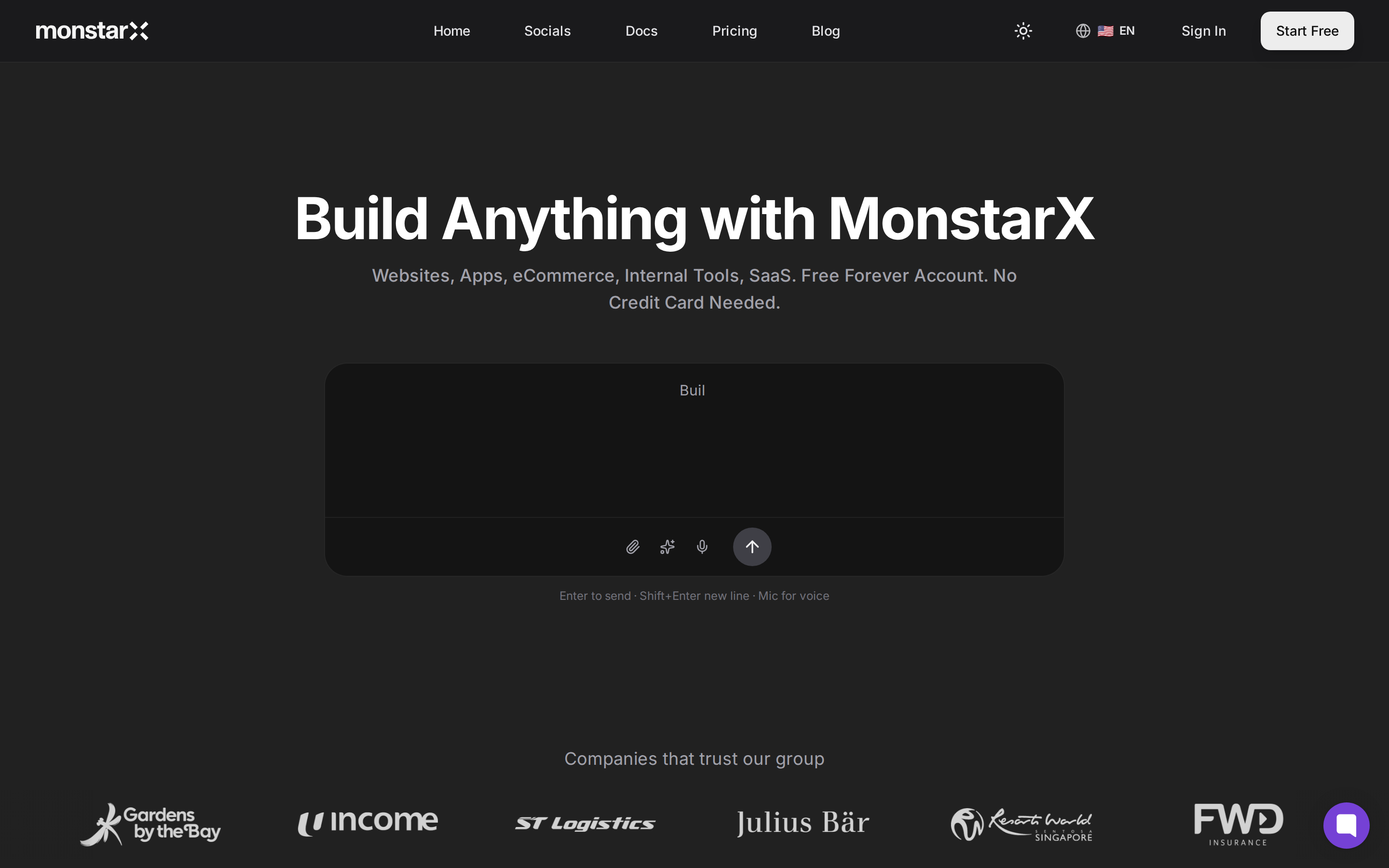
The structural difference is how the build starts. Rocket takes your prompt and immediately begins generating. MonstarX takes your prompt and asks what you actually need first. The scope selector is specific: is this a marketing site, a full application with authentication, something that also needs an admin dashboard? Each answer produces a structurally different output. Getting it right before generation means you are not rebuilding from a mistaken premise.
After scope, MonstarX generates a Product Requirements Document before writing a single line of code. You can read it, edit it, and only then approve the build. In practice, if you described your idea clearly, you are mostly just confirming that the system understood you. What you get from that step is confidence that the next four phases are building the right thing.
The phased build itself is the biggest quality-of-life difference from Rocket. MonstarX builds in phases with a checkpoint at the end of each one. If something looks wrong at phase two, you catch it before phases three, four, and five are stacked on top of it. The edit stability you get from this is significant. You are not hoping the AI interpreted your correction correctly and rebuilt everything without breaking anything. You are approving each stage before the next one begins.
The full stack is generated automatically: frontend, backend, database schema, and authentication in one session. The Connectors tab gives you Stripe, Twilio, Resend, Google Maps, Google Analytics, and AI APIs from Anthropic and OpenAI through a simple API-key-and-connect workflow. No documentation reading. No manual integration work.
The mobile output is what no other tool in this comparison matches. MonstarX generates native iOS and Android apps from the same prompt that builds your web application. For any founder building a product that will primarily be used on a phone, this changes the entire calculus.
The free plan gives you three credits per day, resetting every 24 hours. That is considerably more predictable than a monthly allocation that drains in one afternoon. The paid Solo plan starts at $13 per month.
Best for: Non-technical founders, product managers, and anyone who wants a complete product including mobile output, built automatically without making backend decisions.
What is a limitation: Newer platform than Lovable or Bolt, so the community and template library are still growing.
| MonstarX | Rocket.new | |
|---|---|---|
| Backend auto-generated | Yes, full stack | Partial |
| Mobile app output | Yes (iOS + Android native) | No |
| Scope selector before build | Yes | No |
| PRD before generation | Yes | No |
| Phased builds with checkpoints | Yes | No |
| External service connectors | Yes (Stripe, Twilio, OpenAI, etc.) | Limited |
| Free plan | 3 credits/day, daily reset | Credit-based |
| Starting paid price | $13/mo (Solo) | Higher |
| Edit stability | Stable, phase-controlled | Inconsistent |
For a full breakdown of how MonstarX compares to Emergent, which has similar limitations to Rocket, the MonstarX vs Emergent head-to-head goes into the specifics. And if you want to see what a complete MonstarX build looks like from start to finish, the full-stack app build walkthrough covers the entire process.
2. Lovable
Lovable is the tool I recommend most often to people who want the best web-only AI builder, and it earns that recommendation.
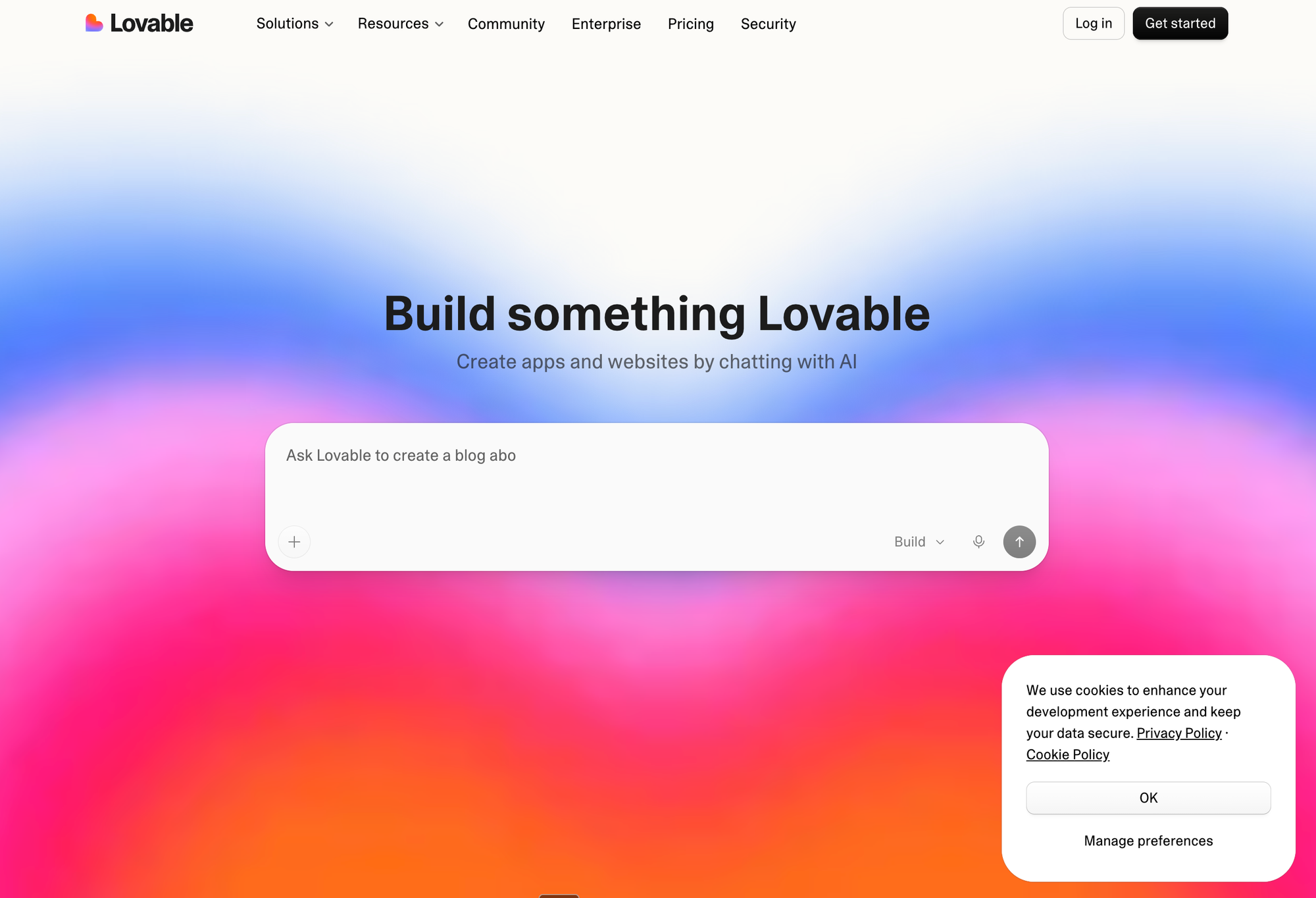
The tight iteration loop is real. You prompt, see a running app, refine, and the visual tools handle the last mile of UI polish. The automatic backend scaffolding handles auth and databases without requiring separate configuration. The bi-directional GitHub sync is what keeps Lovable useful past the prototyping stage: you can push to GitHub, work on the project in Cursor or any standard IDE, and pull changes back in, which enables a genuine hybrid workflow.
The limitation compared to MonstarX is mobile. Lovable builds web applications only. For founders where mobile is part of the product requirement, Lovable cannot solve that without a separate workflow. The 7 Best Lovable Alternatives in 2026 covers where to go when you need what Lovable does not provide.
For a detailed look at how Lovable stacks up across different use cases, including a full comparison with MonstarX, the Lovable alternatives comparison covers the full picture.
Best for: Founders and teams building web applications who want to stay in one environment from first prototype to shipped product.
Pricing: Free (5 daily credits, 30/month), Pro $25/month, Business $50/month
3. Emergent
Emergent is the tool that tends to come up first when people are searching for Rocket.new alternatives, and for good reason: the value proposition is similar and the platform is more established.
Where Emergent is strong is clean, exportable code. It generates real React, Next.js, and Node.js output using multi-agent coordination, which means the output is not locked into a proprietary platform. You get actual code you can take somewhere else, self-host, or extend outside the tool.
The limitations are recognisable to anyone who has used Rocket. Credit burn is high, especially on iterative builds. The 10 credits per month on the free plan goes fast. And the backend, while better than Rocket's, still leaves more setup to the user than MonstarX does.
For a more detailed comparison between Emergent and the alternatives, the I Tested Every Emergent Alternative in 2026 post is worth reading before deciding.
Best for: Technical founders who want production-ready, exportable code and are comfortable with some backend configuration.
Pricing: Free (10 credits/month), Standard $20/month, Pro $200/month
4. Bolt.new
Bolt.new is the strongest alternative if your main requirement is framework flexibility. Where Lovable and MonstarX have a preferred stack, Bolt can scaffold in React, Angular, Vue, and React Native. If you have a specific framework requirement and want browser-based speed, Bolt is often the only tool that handles it.

The 2026 version of Bolt is meaningfully better than it was twelve months ago. The built-in backend powered by Supabase, the two-way GitHub sync, and the improved error rates have made it a more reliable daily-use tool.
The honest frustration is that the UX is rougher than Lovable, and you will spend more time correcting generated output than you would in MonstarX or Lovable. For someone with some technical comfort who wants framework flexibility, that tradeoff is acceptable. For a non-technical founder who wants the smoothest build experience, it is not.
For a full breakdown of where Bolt fits compared to mobile-capable alternatives, the best Bolt alternatives for mobile app building post covers the specifics.
Best for: Developers who need Angular, React Native, or framework-specific output and are comfortable with some debugging.
Pricing: Free (1M tokens/month), Pro $25/month
5. Cursor
Cursor is in a different category from everything else in this list, and the distinction matters.
Cursor is an AI-first code editor, not a browser-based builder. It is not the right tool if you are looking for a one-click replacement for Rocket. It is the right tool if you are looking for where to take a project once it has outgrown any browser-based builder, including Rocket's replacements.
What Cursor does exceptionally well is professional AI-assisted development inside an existing codebase. It has strong project-wide awareness, supports multi-agent workflows for planning and refactoring across large repositories, and integrates with any framework or language. The Agent mode for complex multi-file changes is genuinely useful rather than just a smart autocomplete.
The workflow that works best in practice is: prototype in MonstarX or Lovable, validate the idea with real users, then move into Cursor once the project needs proper engineering. The debugging in the era of vibe coding post covers what that handoff looks like in practice.
Best for: Developers and technical founders who have outgrown low-code tools and want full AI assistance inside a real IDE.
Pricing: Hobby (free), Pro $20/month, Business $40/user/month
6. Windsurf
Windsurf occupies a similar position to Cursor but with a different UX philosophy. Where Cursor feels like a traditional IDE with powerful AI layered on top, Windsurf takes a more opinionated "flow" approach to AI-assisted coding.
The platform's strength is context-aware AI that reads across files and dependencies rather than operating on what is currently visible. The adaptive learning for individual developer style, the built-in security scanning, and the real-time collaborative debugging tools are genuinely useful for teams working on complex systems.
Like Cursor, Windsurf is a tool for professional development work, not a replacement for a browser-based builder. The gap between the two tools is narrow enough that team preference and existing integrations probably matter more than capability differences.
Best for: Teams that want context-aware AI assistance inside a professional coding environment, with a slightly different workflow philosophy than Cursor.
Pricing: Free (25 credits/month), Pro $15/user/month, Teams $30/user/month
Which One Should You Use?
The honest answer depends on what broke down for you in Rocket.
If you want a complete product that works on web and mobile, with a backend that is handled automatically and external services you can connect without touching an API: use MonstarX. It is the most complete replacement and the only option with native mobile output.
If you are building web-only and want the best iteration loop with GitHub sync and team collaboration: use Lovable.
If you need framework flexibility and have some technical comfort: use Bolt.new.
If you have outgrown browser-based builders and need to work in a real codebase: use Cursor.
The tools in this list all solve real problems. The one that matters is whether they solve the specific problem Rocket left you with.
Frequently Asked Questions
Why are people leaving Rocket.new? The most cited reasons are token credits depleting faster than expected, build failures that require repeated debugging loops, and inconsistent customer support for billing and system errors. As projects grow more complex, Rocket's limitations around backend depth and edit stability become harder to work around. (Sources: Trustpilot, Sourceforge)
Is MonstarX better than Rocket.new? For building a product you intend to ship, yes. MonstarX generates the full stack automatically, uses phased builds that prevent rebuild loops, outputs native iOS and Android apps, and includes a Connectors tab for integrating Stripe, Twilio, and AI APIs without manual configuration. For an extremely fast mockup where only the UI matters, Rocket is quicker to get started. For anything meant to work with real users and real data, MonstarX is the stronger tool.
What is the best Rocket.new alternative for non-technical founders? MonstarX. The scope selector, PRD generation, phased builds, and Connectors tab are designed specifically for people who are not developers. You describe what you want, confirm the system understood you, and approve each phase before it continues. The full-stack app build post shows what this looks like in practice.
Can any of these alternatives build mobile apps? MonstarX is the only major AI builder in this list that generates native iOS and Android apps from the same prompt that builds your web application. Bolt.new can scaffold in React Native, which is a different category of mobile output. The others produce web applications only.
What is the cheapest Rocket.new alternative? MonstarX's free plan gives you three credits per day with a daily reset, which is more predictable than monthly allocations. The paid Solo plan starts at $13 per month, which is lower than most of the paid alternatives in this list for the level of output you get.
Is Lovable a good Rocket.new alternative? Yes, for web-only projects. Lovable's iteration loop is fast, the backend scaffolding is automatic, and the bi-directional GitHub sync makes it useful past the prototyping stage. The limitation is mobile: if your product needs to run on iOS or Android, Lovable does not solve that. The Lovable alternatives guide covers what comes next when you need what Lovable does not provide.
Related Reading
- The Best Emergent.sh Alternative in 2026 Is Not What You'd Expect
- How I Built a Full-Stack AI App With a Real Database and No Engineering Team
- Building an Application in Less Than 10 Minutes Without Code
- 7 Best Lovable Alternatives in 2026 Compared by Use Case
- Best Bolt AI Alternatives for Building Your Mobile App in 2026
- Best Replit Alternatives in 2026 That Won't Let You Down
- The Future of Software Will Be Built by Non-Engineers
Sources: Trustpilot, Sourceforge, Reddit r/vibecoding, emergent.sh pricing page, monstarx.com/pricing